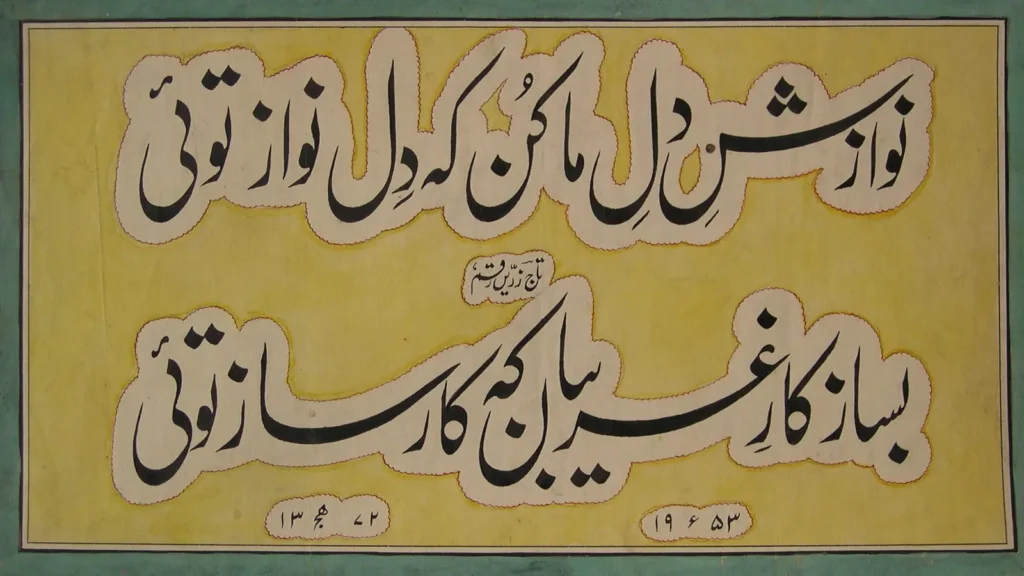

Islamic calligraphy is the decorative writing of the Arabic script, used mainly to transmit a text. Ibn Muqla and his brother are credited with defining the shapes of the letters around the turn of the tenth century, and Yaqut al-Musta’simi picked the six scripts known as the Six Pens. Nasta’liq developed in Persia in the fourteenth century.
What Islamic calligraphy is, and why it holds such a place
The Metropolitan Museum of Art’s Department of Islamic Art calls calligraphy the most highly regarded and most fundamental element of Islamic art. The Qur’an was transmitted in Arabic, and the Arabic script itself holds the potential for developing a variety of ornamental forms. Most calligraphic works carried legible inscriptions, though not every Muslim could read them. Even so, calligraphy remains principally a means to transmit a text, albeit in a decorative form.
Tools and materials
Encyclopaedia Iranica’s entry on writing implements says that in the traditional craft only reed pens (qalam) are used, with the nib cut to different widths and degrees of sharpness for different scripts. In former times calligraphers prepared their own ink, paper and rulers. Ink could be deep black, ordinary black, greyish black or greenish black, and paper was stiffened with starch and glazed.
The Met’s essay on the arts of the book in the Islamic world adds that a scribe made his pens and prepared his ink from carbon boiled with gallnuts, then pressed guidelines into the paper. Paper was made from rags of linen and hemp, not tree pulp. Sheets were tinted, sprinkled with gold or marbled before a starchy solution gave them a smooth surface.
Kufic and the early scripts
Iranica’s entry on the scripts says Kufic stayed in common use in Persia for five centuries after the Arab conquest, mainly for copying the Qur’an and for decorating buildings, vessels and books. Manuscript Kufic has simple shapes, while the building style, called maqeli or banna’i, is entirely straight. Naskh was used for communication, while Kufic became an art.

Ibn Muqla, Yaqut and the Six Pens
Ibn Muqla, who died in 940, was a vizier of the caliph al-Muqtadir. Iranica credits him and his brother with putting a stop to the proliferation of styles around the turn of the tenth century. They selected fourteen styles and defined the geometric shapes of the letters by improving the pens, and their rules rested on straightness and roundness. Ibn al-Bawwab, who died in 1022 or 1023, added rules on nib cutting and ink and began measuring letters in points. He also improved thuluth, naskh and riqa.
Yaqut al-Musta’simi, who died about 1298, picked six scripts to improve: thuluth, naskh, rayhan, muhaqqaq, tawqi and riqa. Known as the setta-ye yaquti, or Six Pens, they gradually supplanted all the other scripts except Kufic.
After Ibn Muqla’s rules, most Qur’ans and other books came to be written in naskh. Muhaqqaq, the first script he systematised, is stately but simple. Iranica calls thuluth the most beautiful and admired of the Islamic scripts. It has also been called the mother script, though in Persia it was seldom used for the main text of Qur’ans. Tawqi, a thuluth derivative, was used for decrees and colophons, and riqa, a simplified script for short messages, endured in Persia. The minute script called ghubar is a later development, and the diwani script of the Ottomans and Egyptians derives from ta’liq.
Nasta’liq in Persia and South Asia
Nasta’liq, from naskh-ta’liq, developed on Persian ground in the second half of the fourteenth century. Sixteenth-century sources credit Mir Ali Tabrizi, whom the Smithsonian describes as active about 1370 to 1410, with inventing it. Legend has it that Ali ibn Abi Talib told him in a dream to draw letters like the wings of flying geese. The Smithsonian adds that scholars have recently argued that the script emerged gradually in Shiraz and Tabriz, and Iranica says Mir Ali systematised it and gave it its definitive shape.
From the early fifteenth century Persians did most of their writing in nasta’liq, and Muslim Indians, Ottoman Turks and others adopted it to some extent. Specialists recognise traces of a “western” style of nasta’liq, discarded in Persia, in the work of Afghan, Indian and Pakistani calligraphers.
Mughal albums, called muraqqa, joined paintings with pages of illuminated calligraphy. A folio in the Met’s Shah Jahan Album shows the work of Sultan Ali al-Mashhadi (about 1440 to 1520), described there as a venerated calligrapher of the Timurid court.
Calligraphy at Fakir Khana Museum
Fakir Khana Museum describes a wooden panel on which the Kalima, its word for the Muslim declaration of faith, is carved in relief. It describes a sheet of nasta’liq written in diagonal lines, each word set in a pink cloud band on a gold-sprinkled ground and mounted on lilac paper. A handwritten illustrated manuscript is open at a painting of a horse and two figures beneath a flowering tree.
Visits are by appointment. Call or write to arrange one. When you do, please ask what is on show and about admission.
Read more about Islamic calligraphy at Fakir Khana or explore the collection.

Frequently Asked Questions
What are the Six Pens in Islamic calligraphy?
The Six Pens, or setta-ye yaquti, are the six scripts that Yaqut al-Musta’simi, who died about 1298, picked to improve: thuluth, naskh, rayhan, muhaqqaq, tawqi and riqa. Encyclopaedia Iranica says they gradually supplanted all the other scripts except Kufic.
Who was Ibn Muqla?
Ibn Muqla, who died in 940, was a vizier of the caliph al-Muqtadir. Encyclopaedia Iranica credits him and his brother with putting a stop to the proliferation of styles around the turn of the tenth century: they selected fourteen styles and set down rules built on straightness and roundness.
Who developed the nasta’liq script used in Persia and South Asia?
Sixteenth-century sources credit Mir Ali Tabrizi with inventing nasta’liq, and legend has it that Ali ibn Abi Talib told him in a dream to draw letters like the wings of flying geese. The Smithsonian says scholars have recently argued that the script emerged gradually in Shiraz and Tabriz, and Encyclopaedia Iranica says Mir Ali systematised it and gave it its definitive shape.
What tools did Islamic calligraphers use?
In the traditional craft, Encyclopaedia Iranica says, only reed pens (qalam) are used, with the nib cut to different widths and sharpness for different scripts. Calligraphers once prepared their own ink, paper and rulers; ink could be deep black, ordinary black, greyish black or greenish black, and paper was stiffened with starch and glazed.
What calligraphy is in the Fakir Khana Museum collection?
The museum describes a wooden panel with the Kalima, its word for the Muslim declaration of faith, carved in relief, and a sheet of nasta’liq set in diagonal lines on a gold-sprinkled ground. It also describes a handwritten illustrated manuscript. Visits are by appointment. Call or write to arrange one.
Sources and Further Reading
- Calligraphy in Islamic Art, The Metropolitan Museum of Art — Calligraphy as the most fundamental element of Islamic art, and the Arabic script as ornament and a means to transmit a text.
- Calligraphy I. The Beginnings, Encyclopaedia Iranica — Ibn Muqla and his brother, Ibn al-Bawwab, and Yaqut al-Musta’simi’s six scripts.
- Calligraphy II. Scripts, Encyclopaedia Iranica — Kufic in Persia, naskh, muhaqqaq, thuluth, tawqi, riqa and the development and spread of nasta’liq.
- Calligraphy VI. Writing Implements and Materials, Encyclopaedia Iranica — Reed pens, nib cutting, ink tones and starch-stiffened glazed paper.
- The Arts of the Book in the Islamic World, 1600-1800, The Metropolitan Museum of Art — A scribe’s own ink and pens, ruled guidelines, and paper made from linen and hemp rags prepared with a starchy solution.
- Nasta’liq: The Genius of Persian Calligraphy (Mir Ali Tabrizi), Smithsonian National Museum of Asian Art — Mir Ali Tabrizi’s dates, the gradual emergence of nasta’liq in Shiraz and Tabriz, and the flying-geese dream legend.
- The Shah Jahan Album, The Metropolitan Museum of Art — Mughal albums and the work of Sultan Ali al-Mashhadi.