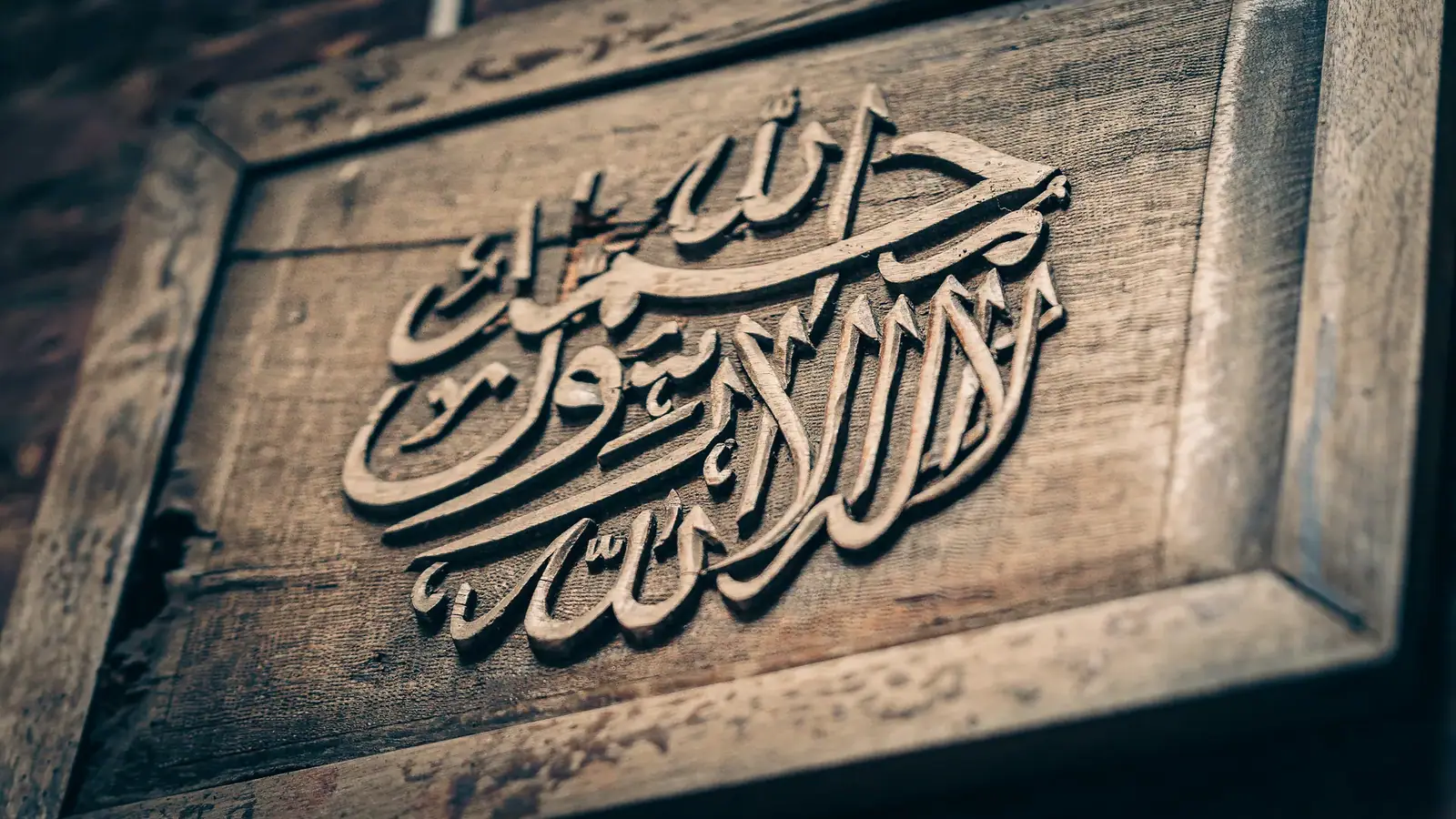
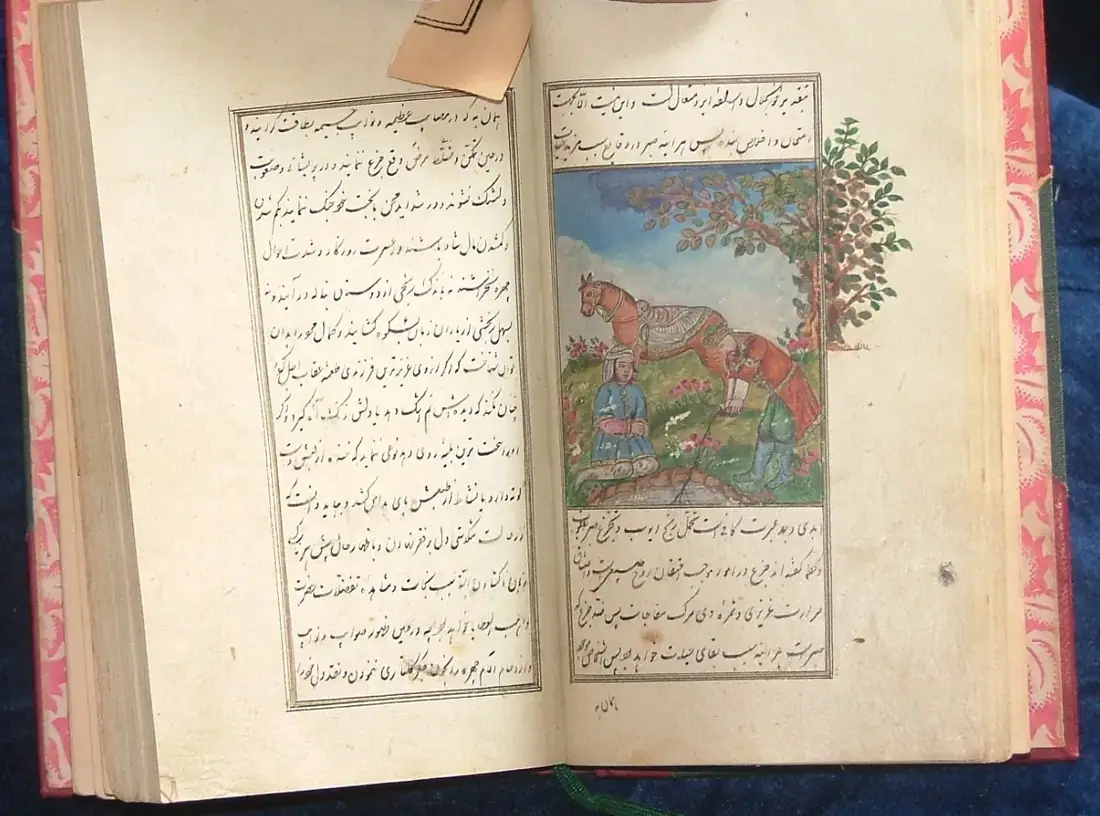
Fakir Khana Museum describes a wooden panel with the Kalima, the Muslim declaration of faith, carved in relief. Two further works in its photographs carry writing: diagonal lines of nasta’liq script in pink cloud bands on a gold-sprinkled ground, and a handwritten book open at a small painting.
The carved Kalima panel
In the museum’s photograph, the panel is weathered wood in a plain wooden frame, and its Arabic letters stand out in raised relief under light falling across the surface at an angle. The museum’s word for the text is Kalima. The declaration of faith, the shahadah, is the first of the five Pillars of Islam.
Nasta’liq in cloud bands
In the museum’s words, the second work is made of diagonal lines of nasta’liq script, each word set in a pink cloud band on a gold-sprinkled ground, mounted on lilac paper. In the photograph the script is in black ink, each group of words sits inside a scalloped cloud shape, and smaller clouds near the top and lower edges hold short lines.
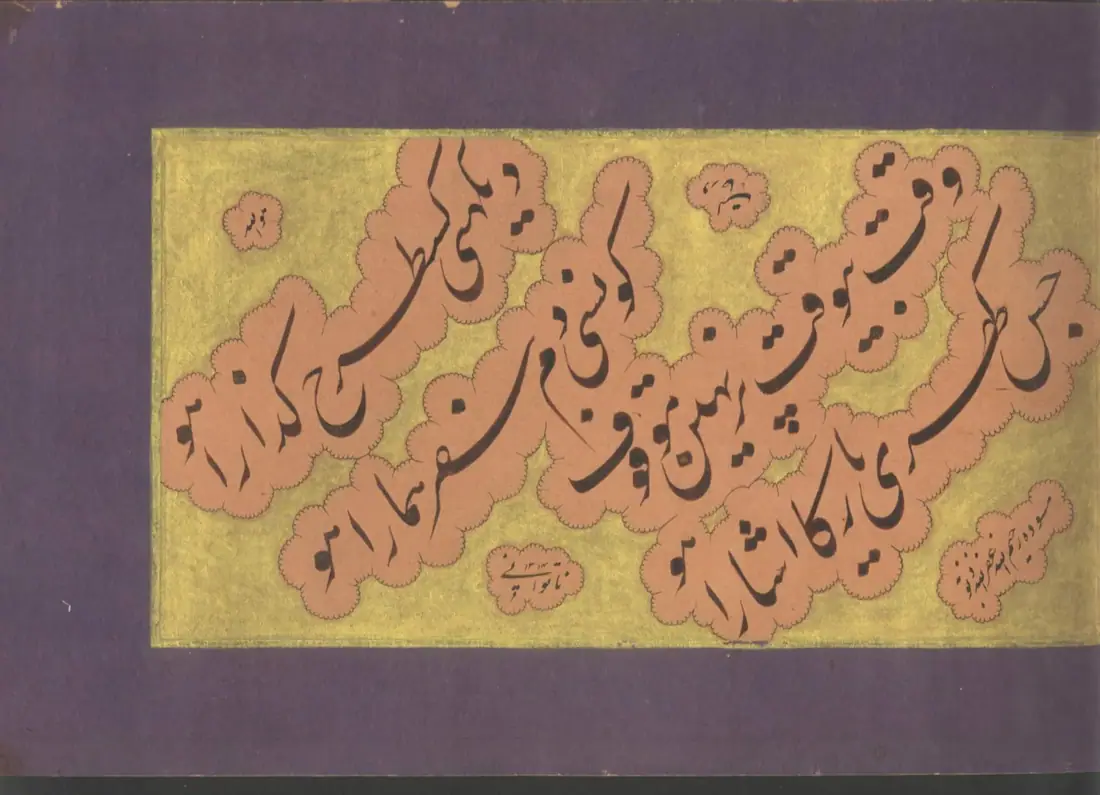
The Metropolitan Museum of Art’s essay on the arts of the book in the Islamic world, 1600 to 1800, records decorative touches added to paper, such as tinting and sprinkling with gold.
An illustrated manuscript
The museum describes the third work as a handwritten book open at a painting of a horse and two figures beneath a flowering tree. In the photograph the book is bound in red, each block of text sits in a frame of ruled lines, and the small painting appears on the right-hand page. The museum adds that the family’s library once ran to thousands of volumes.
Reading calligraphy as art
The Metropolitan Museum of Art’s essay on calligraphy in Islamic art calls it the most highly regarded and most fundamental element of Islamic art. The Qur’an was transmitted in Arabic, the essay explains, and the script lends itself to ornament. Calligraphy remains principally a means of transmitting a text, albeit in a decorative form. The museum’s own entry on Google Arts and Culture says calligraphy is considered an elevated form of art in Islam.
Separately, a study by Kanwal Khalid of the University of the Punjab says that the Fakir family’s publishing house in Bazaar Hakeeman brought in paper makers, and that paper made under its supervision was very fine. Most manuscripts produced in Maharaja Ranjit Singh’s period, Khalid adds, were made on Lahori Kaghaz, or Lahori paper.
Where the sources differ
The Smithsonian National Museum of Asian Art notes that biographies and treatises composed in sixteenth-century Iran credit Mir Ali Tabrizi, active about 1370 to 1410, with inventing nasta’liq. It adds that scholars have recently argued the script emerged gradually in the second half of the fourteenth century in the cities of Shiraz and Tabriz.
Explore the collection. Visits are by appointment. Call or write to arrange one.
For background on the scripts discussed here, read the introduction to Islamic calligraphy.
Frequently Asked Questions
What is the Kalima?
The museum uses Kalima for the Muslim declaration of faith, the shahadah, which is the first of the five Pillars of Islam. Fakir Khana Museum describes one of its works as the Kalima carved in relief on a wooden panel.
Who invented the nasta’liq script?
The Smithsonian National Museum of Asian Art notes that sixteenth-century Iranian biographies and treatises credit Mir Ali Tabrizi, active about 1370 to 1410, with inventing nasta’liq. It adds that scholars have recently argued the script emerged gradually in the second half of the fourteenth century in Shiraz and Tabriz.
How is the nasta’liq arranged on the gold-sprinkled sheet?
In the museum’s description, the nasta’liq script runs in diagonal lines, each word set in a pink cloud band on a gold-sprinkled ground, and the whole is mounted on lilac paper.
What does the handwritten book at Fakir Khana show?
The museum describes it as a handwritten book open at a painting of a horse and two figures beneath a flowering tree. It adds that the family’s library once ran to thousands of volumes.
How do I arrange a visit to Fakir Khana Museum?
Visits are by appointment. See Plan Your Visit for directions and booking enquiries. Please ask about admission when you arrange your visit, and ask before taking photographs. You can also ask then which works are on show.
Sources and Further Reading
- Calligraphy in Islamic Art: The Metropolitan Museum of Art — Calligraphy as the most highly regarded and most fundamental element of Islamic art, and as a decorative means of transmitting a text
- The Arts of the Book in the Islamic World, 1600-1800: The Metropolitan Museum of Art — Decorative touches added to paper, including tinting and sprinkling with gold
- Nasta’liq: The Genius of Persian Calligraphy (Mir Ali Tabrizi): Smithsonian National Museum of Asian Art — Sixteenth-century credit to Mir Ali Tabrizi and recent scholarship on nasta’liq emerging gradually in Shiraz and Tabriz
- Google Arts and Culture: Fakir Khana Museum exhibit — The museum’s entry, which describes calligraphy as an elevated form of art in Islam
- Shahadah: Encyclopaedia Britannica — The Muslim profession of faith as the first of the five Pillars of Islam
- Kanwal Khalid, University of the Punjab — The Fakir family’s publishing house in Bazaar Hakeeman bringing in paper makers, and Lahori Kaghaz in Ranjit Singh’s period