
Fakir Khana Museum in Lahore holds a fine Kashmiri shawl that the museum believes belonged to Maharani Jind Kaur, the wife of Maharaja Ranjit Singh. The museum’s online record says she presented it to Qamaruddin of the Fakir family. The museum’s photograph shows a cream ground with a broad paisley border.
The shawl and how it is described
The museum says its textile collection belongs almost entirely to the nineteenth-century Sikh period, and it counts this shawl among the highlights. The museum’s online description calls the shawl pashmina with very fine cut work and embroidery, and says it can be worn both ways.
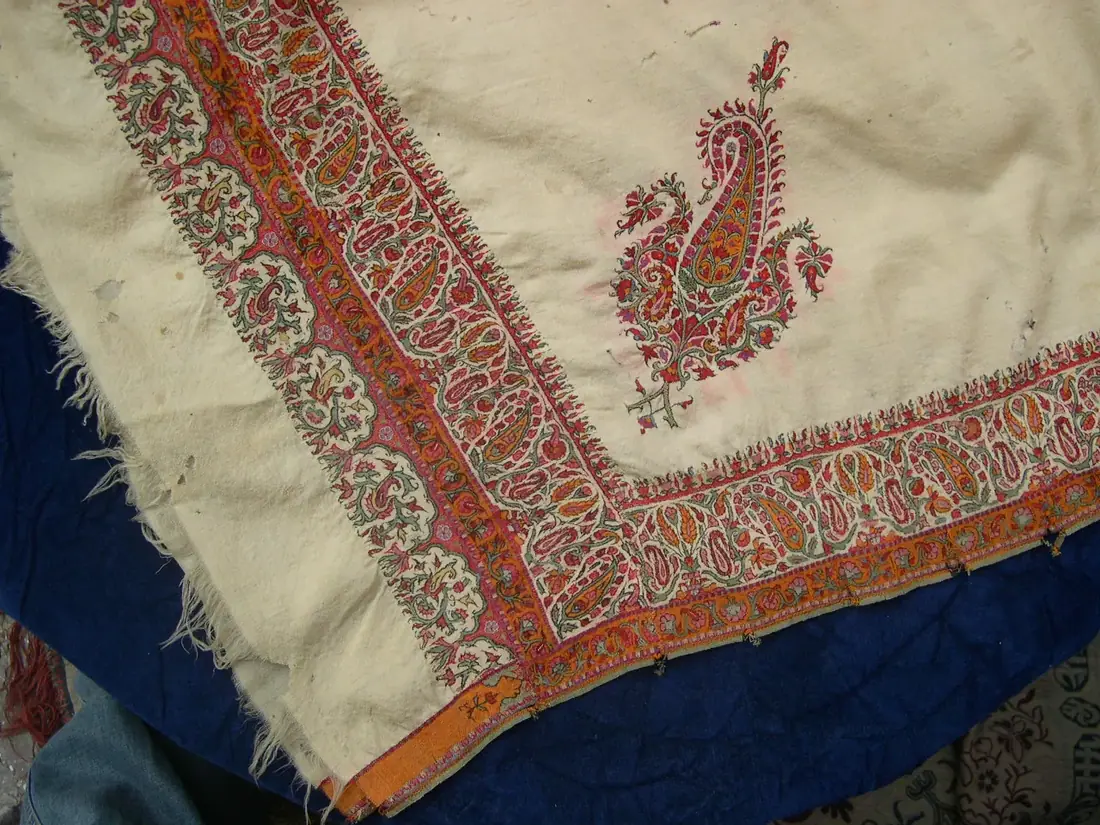
The museum’s photograph shows one corner of the shawl, with a frayed edge. A broad border of paisley forms in red, orange, green and pink runs along two edges, and a single large paisley motif on a floral stem stands in the field near the corner.
Who Maharani Jind Kaur was
Maharani Jind Kaur (1817 to 1863), popularly known as Jindan, was the wife of Maharaja Ranjit Singh and the mother of Maharaja Duleep Singh, the last Sikh sovereign of the Punjab. After Maharaja Sher Singh and Dhian Singh were assassinated in September 1843, the army proclaimed the minor Duleep Singh sovereign on 16 September. The Encyclopaedia of Sikhism records that she gradually took on the role of regent and conducted state business in public.
The same entry says that in December 1846 she gave up political power to a council appointed by the British Resident. She was moved to Sheikhupura in September 1847 and then sent to Banaras, where she was interned under strict surveillance. She escaped to Nepal and reached Kathmandu in April 1849. She stayed in Nepal until 1860, then travelled to Calcutta to meet her son, who took her to England. She died at Kensington on 1 August 1863.
Kashmiri shawls at the Sikh court
Frank Ames writes in Textiles Asia (2011) that Ranjit Singh annexed Kashmir in 1819, and that around 1820 Kashmir shawls changed within a few years from simple paisley repeats at each end to patterns across the whole shawl. At Lahore, shawls were gifts of favour: the Encyclopaedia of Sikhism records that in January 1841 Maharani Chand Kaur gave presents, shawls among them, to the officers while she defended the throne against Sher Singh.
Janet Rizvi explains in the Encyclopedia of India that pashm, called cashmere in the West, is the raw wool and pashmina the cloth woven from it. The earliest surviving shawls carry a single flowering plant repeated at each end, and the bent-tip buta that grew out of it later became known as the paisley, after the Scottish town. She adds that under Afghan, Sikh and Dogra rule heavy taxes bore on the industry, and weavers who could escape emigrated to the Punjab and elsewhere in north India. None of this dates the shawl at Fakir Khana.
What the family says about its history
The museum’s record says the Maharani herself presented the shawl to Qamaruddin of the Fakir family. Gulf News reported in 2018 that the museum’s director, shown the shawl on a visit, called it the shawl of the wife of Maharaja Ranjit Singh.
The family also appears in Jind Kaur’s own story. The Encyclopaedia of Sikhism entry on Nuruddin, written by F.S. Aijazuddin, a writer from the Fakir family, records that Qamaruddin travelled with his father, Fakir Nuruddin, as escort when she was exiled to Banaras. Aijazuddin’s 2002 article says Nuruddin accompanied her when she was sent out of the Punjab in the summer of 1848, and that Qamaruddin went with her too.
Seeing it at the museum
Visits to Fakir Khana Museum are by appointment. Call or write to arrange one through the Visit page, and ask whether the shawl can be seen. Please ask before taking photographs; your guide will tell you what is possible.
Frequently Asked Questions
Does Fakir Khana Museum hold a shawl associated with Maharani Jind Kaur?
Yes. Fakir Khana Museum holds a fine Kashmiri shawl that the museum believes belonged to Maharani Jind Kaur, wife of Maharaja Ranjit Singh and mother of Maharaja Duleep Singh. The museum’s online record says she presented the shawl to Qamaruddin of the Fakir family.
What does the Maharani Jind Kaur shawl at Fakir Khana look like?
The museum’s online description calls it pashmina with very fine cut work and embroidery, and says it can be worn both ways. In the museum’s photograph the ground is cream with a frayed edge, a broad paisley border in red, orange, green and pink runs along two edges, and one large paisley on a floral stem stands near the corner.
Is the shawl proven to have belonged to Maharani Jind Kaur?
The museum believes it was hers, and its online record says she presented it to Qamaruddin of the Fakir family. Gulf News reported in 2018 that the museum’s director called it the shawl of the wife of Maharaja Ranjit Singh. The attribution is the museum’s own.
How was the Fakir family connected to Maharani Jind Kaur?
The Encyclopaedia of Sikhism entry on Nuruddin, written by F.S. Aijazuddin, a writer from the Fakir family, records that Qamaruddin travelled with his father, Fakir Nuruddin, as escort when she was exiled to Banaras. Aijazuddin’s 2002 article says Nuruddin accompanied her in the summer of 1848, and that Qamaruddin went with her too.
Can visitors see Maharani Jind Kaur’s shawl at Fakir Khana Museum?
Visits to Fakir Khana Museum, inside Bhati Gate in Lahore, are by appointment. Call or write to arrange one, and ask whether the shawl can be seen. Please ask before taking photographs; your guide will tell you what is possible.
Sources and Further Reading
- Shawl, Maharani Jindah: Fakir Khana Museum (Google Arts & Culture) — The museum’s description of the pashmina shawl (cut work and embroidery, wearable both ways) and its record that the Maharani presented it to Qamaruddin.
- Fakir Khana Museum: Google Arts & Culture Story — The museum’s statement that its textile collection belongs almost entirely to the 19th-century Sikh period and includes a fine Kashmiri shawl believed to have been owned by Maharani Jind Kaur.
- Jind Kaur Maharani (1817-1863): Encyclopaedia of Sikhism — The biography of Maharani Jind Kaur: the regency, loss of power in 1846, removal to Sheikhupura and Banaras, Nepal until 1860, and death at Kensington on 1 August 1863.
- Nur ud-Din Faqir (d. 1852): Encyclopaedia of Sikhism — Qamaruddin travelling with his father as escort to Maharani Jind Kaur when she was exiled to Banaras.
- F.S. Aijazuddin (2002), Archive Article — Nuruddin and Qamaruddin accompanying Maharani Jind Kaur during her exile from the Punjab, and the summer of 1848.
- Gulf News (2018), A museum is witness to Lahore’s rich past — The 2018 report of the museum’s director speaking of the shawl as that of Maharaja Ranjit Singh’s wife.
- Kashmir Shawls: Encyclopedia of India (Janet Rizvi) — The pashm and pashmina definitions, the early single-plant design and the paisley, and the emigration of weavers to the Punjab.
- Frank Ames, Khalsa and Explosive Graphics in the Age of Maharaja Runjit Singh’s Kashmir (Textiles Asia, 2011) — Ranjit Singh’s annexation of Kashmir in 1819 and the change in Kashmir shawl design around 1820.
- Sher Singh Maharaja (1807-1843): Encyclopaedia of Sikhism — Maharani Chand Kaur giving presents, shawls among them, to the officers in January 1841.