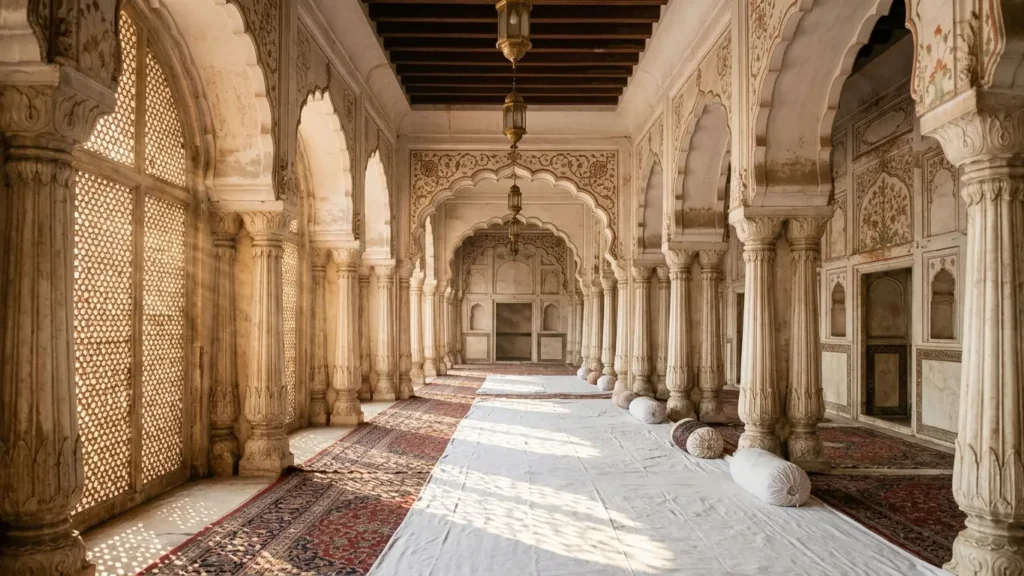

Maharaja Ranjit Singh, popularly called Sher-i-Punjab, the Lion of the Punjab, was born at Gujranwala in 1780 and took Lahore in 1799. He was proclaimed Maharaja in 1801 and ruled until his death on 27 June 1839. His court drew on Sikh, Hindu, Muslim and European officials.
Early life in Gujranwala
Most dates here come from the Encyclopaedia of Sikhism, which gives Ranjit Singh’s birth as 13 November 1780 at Gujranwala, now in Pakistan. He was the only son of Maha Singh Sukkarchakkia and Raj Kaur, daughter of Raja Gajpat Singh of Jind. He was named Buddh Singh at birth, and the name was changed to Ranjit, meaning victor in battle, to mark a victory won by his father.
Smallpox took the sight of his left eye when he was a child. He attended no school, and the Wallace Collection calls him unlettered but credits him with a prodigious memory and organisational abilities. He inherited his father’s estates as a boy. The Encyclopaedia says he showed little interest in running them, so his mother and his father’s manager, Lakhpat Rai, and then his maternal uncle and his mother-in-law, Sada Kaur, managed them. In 1796 he married Mahitab Kaur at Batala, a daughter of Sada Kaur of the Kanhaiya misl. The Wallace Collection says the marriage united two previously warring Sikh confederacies.
Taking Lahore in 1799
Ranjit Singh took Lahore in 1799, and from then on he made the Lahore Fort his headquarters. The Encyclopaedia says Shah Zaman of Kabul had occupied the city in the autumn of 1798 and withdrew when trouble broke out at home, and it dates the takeover to 7 July 1799, when Ranjit Singh drove the Bhangi rulers out and became master of the capital.
On Baisakhi day, 12 April 1801, Sahib Singh Bedi, a Sikh in direct descent from Guru Nanak, applied the saffron mark to Ranjit Singh’s forehead and proclaimed him Maharaja of the Punjab. At the proclamation, the Encyclopaedia says, he refused to wear royal emblems or sit on a throne and went on holding darbar seated cross-legged in a chair. It adds that he had coins struck in the name of the Guru and that the government was styled Sarkar Khalsaji. His own dress stayed plain beside his richly robed courtiers, although on special occasions he wore the Koh-i-Noor diamond on his arm. For a surviving textile associated with the Maharaja, see his jamawar robe and sash at Fakir Khana.
In 1802 he took Amritsar, the holy city of the Sikhs and the chief trading centre of the Punjab. The Encyclopaedia says he ordered the Harimandar to be rebuilt in marble and its domes covered with gold leaf.
Building the Sikh Empire
In April 1809 Ranjit Singh signed a treaty of friendship with the British at Amritsar. It barred him from extending his influence beyond the Sutlej and left him master of the territories he already held south of the river, but it let him consolidate his power in the Punjab and pursue conquests to the north and west.
His major conquests began with the occupation of Multan in 1818, and Kashmir was annexed in 1819. Peshawar came under his direct control in 1834.
At its height his domain stretched from the Khyber Pass in the west to the Sutlej in the east, and from northern Kashmir to the deserts of Sindh, in four provinces: Lahore, Multan, Peshawar and Kashmir. The Encyclopaedia estimates its area at 100,436 square miles and its population at 5,350,000. The empire also reached into Ladakh and Afghan territories to the west.
He put one third of his entire revenue into his army, the Encyclopaedia says. From 1822 he took Napoleonic veterans such as Allard and Ventura into his service to modernise it, and the Wallace Collection says the reorganised army kept any British, Afghan or Russian threat at bay for four decades.
A plural court: who served the Maharaja
Khushwant Singh’s entry in the Encyclopaedia says the central government ran through about a dozen departments headed by chosen men, among them the wazir, the lord chamberlain, the heads of the treasury and foreign affairs and the councillors of religious affairs. In appointing ministers and councillors, the entry says, Ranjit Singh was his own judge, and efficiency was the main criterion, without regard to caste or creed.
The entry names among the first families to rise the sons of Ghulam Mohi ud-Din of Lahore, known as the Fakirs, of whom the eldest, Fakir Azizuddin, was closest to the Maharaja and advised him on external affairs. Khushal Chand, a Brahman from Meerut, became Khushal Singh and chamberlain, and when he fell from favour Dhian Singh Dogra of Jammu took his place. The Walled City of Lahore Authority describes Raja Dina Nath, from a Kashmiri Pandit family, as a courtier and civil administrator of considerable influence at the Sikh court for well over three decades.
Westerners at the court included Company deserters, mercenaries and medical men from Europe and the United States, and the Wallace Collection says that together they made almost certainly the most cosmopolitan court in the world at that time. The army was mixed too: its nucleus was Sikh, with large contingents of Muslims, mainly in the artillery, and of Hindus.
In Khushwant Singh’s reading, Ranjit Singh intended a state in which Muslims, Hindus and Sikhs had equal rights, and the entry adds that there were no forced conversions in his time. Baron Charles Hugel, quoted there, judged that perhaps no empire so large had been founded by one man with so little criminality.
The Fakir brothers at his side
Three Muslim brothers, Fakir Azizuddin, Fakir Imamuddin and Fakir Nuruddin, served Ranjit Singh as ministers and emissaries. A Dawn review of The Resourceful Fakirs, a book by F.S. Aijazuddin, a writer from the same Fakir family, calls them all trusted ministers of the Maharaja. The Encyclopaedia says Imamuddin and Nuruddin also held important positions in the Darbar, and F.S. Aijazuddin says the three served from the earliest years of his reign. The brothers’ dates are set out together in a timeline.

Azizuddin became the Maharaja’s personal physician in 1799, after being sent to treat his eye ailment, and was given a jagir and the drafting of state papers in Persian. Majid Sheikh in Dawn also says Azizuddin became a personal physician in 1799, and F.S. Aijazuddin says Azizuddin cured a threatening infection of the Maharaja’s “precious single eye”.
Imamuddin was qiladar, or keeper, of Gobindgarh Fort at Amritsar, where the Sikh crown jewels were kept; F.S. Aijazuddin calls it the Maharaja’s treasury fort. Nuruddin was appointed court physician in 1801, the Encyclopaedia says, and later served as a provincial governor and, after Ranjit Singh’s death, as a member of the Council of Regency.
Stories about the Maharaja’s blind eye come from family and newspaper accounts, and all of them are tradition. A family account recorded in Tanqeed in 2016 holds that, at the 1831 meeting with Lord William Bentinck, Azizuddin said he had never looked at the Maharaja’s face closely enough to know which eye was blind. In Majid Sheikh’s column, the young physician, asked to restore the lost eye, is said to have replied that it would be better to see the world with the same eye.
Where the sources differ
Most historians place his birth at Gujranwala, as the Encyclopaedia does; a popular tradition, promoted by governments of Indian Punjab, names Badrukhan in Sangrur district. On how he won Lahore, the Wallace Collection says he forced Shah Zaman to grant it and then seized it, the Encyclopaedia says the populace welcomed him as their redeemer, and a family account in Tanqeed speaks of an invitation signed by 18 families.
Death in 1839 and what followed
Ranjit Singh died of paralysis at Lahore on 27 June 1839 and was succeeded by his eldest son, Kharak Singh. His tomb adjoins the Lahore Fort. F.S. Aijazuddin says Azizuddin kept the Maharaja’s trust until his death and ministered to him to the end, and Majid Sheikh also places Azizuddin by his side.
The empire collapsed within a decade of his death. Nau Nihal Singh died in 1840, Sher Singh was installed in 1841 and assassinated in 1843, and Hira Singh was killed in 1844, after which Maharani Jind Kaur acted as regent for the minor Duleep Singh. The Treaty of Lahore of 9 March 1846 came after the first Anglo-Sikh war, and the Punjab was annexed on 29 March 1849.
Visits to Fakir Khana Museum, the Fakir family’s museum in the Walled City of Lahore, are by appointment. Call or write to arrange one through the Visit page, or meet the family who served him.
Frequently Asked Questions
When and where was Maharaja Ranjit Singh born?
The Encyclopaedia of Sikhism gives 13 November 1780 at Gujranwala, now in Pakistan, and names his parents as Maha Singh Sukkarchakkia and Raj Kaur. A popular tradition in Indian Punjab names Badrukhan in Sangrur district instead, but most historians place his birth at Gujranwala.
When did Ranjit Singh take Lahore and become Maharaja?
Ranjit Singh took Lahore in 1799, and the Encyclopaedia of Sikhism dates the takeover to 7 July 1799, when he drove out the Bhangi rulers. It dates his proclamation as Maharaja of the Punjab to Baisakhi day, 12 April 1801. Accounts of how Lahore received him differ.
Who were the Fakir brothers at Ranjit Singh’s court?
Three Muslim brothers served him as ministers and emissaries. The Encyclopaedia of Sikhism describes Fakir Azizuddin as his personal physician from 1799 and adviser on external affairs, Fakir Imamuddin as qiladar of Gobindgarh Fort at Amritsar, and Fakir Nuruddin as court physician from 1801 and later a provincial governor.
When and how did Maharaja Ranjit Singh die?
He died of paralysis at Lahore on 27 June 1839 and was succeeded by his eldest son, Kharak Singh. F.S. Aijazuddin, a writer from the Fakir family, and Majid Sheikh in Dawn both place Fakir Azizuddin at his side. The Wallace Collection says the empire collapsed within a decade, and the Punjab was annexed on 29 March 1849.
Sources and Further Reading
- Ranjit Singh (1780-1839): Encyclopaedia of Sikhism — Main reference for his birth, the taking of Lahore, the 1801 proclamation, the conquests, the extent of his domain, the court and his death.
- Maharaja Ranjit Singh, Lion of the Punjab: The Wallace Collection — His early years, the 1796 marriage alliance, the Western officers at his court, the make-up of the army and the collapse of the state after his death.
- Maharaja Ranjit Singh (1780-1839): Fran Pritchett, Columbia University — The Sher-i-Punjab epithet, his headquarters in the Lahore Fort, the conquests of 1818 and 1819 and his tomb beside the fort.
- F.S. Aijazuddin: article on the Fakir family — The roles of the three Fakir brothers, Azizuddin’s treatment of the Maharaja’s eye and his presence at the Maharaja’s death.
- Dawn: column by Majid Sheikh on Fakir Azizuddin — Azizuddin as a physician from 1799, his place at the Maharaja’s side at his death and one telling of the blind-eye story.
- A visit to the Fakir Khana: Tanqeed — A family account of the 1831 meeting with Lord William Bentinck and of the invitation said to have been signed by 18 families of Lahore.
- Aziz ud-Din Faqir (1780-1845): Encyclopaedia of Sikhism — Fakir Azizuddin’s appointment as personal physician in 1799, his jagir and his drafting of state papers in Persian.
- Dawn: review of The Resourceful Fakirs — A review of F.S. Aijazuddin’s book on the three brothers, which calls them trusted ministers of the Maharaja.