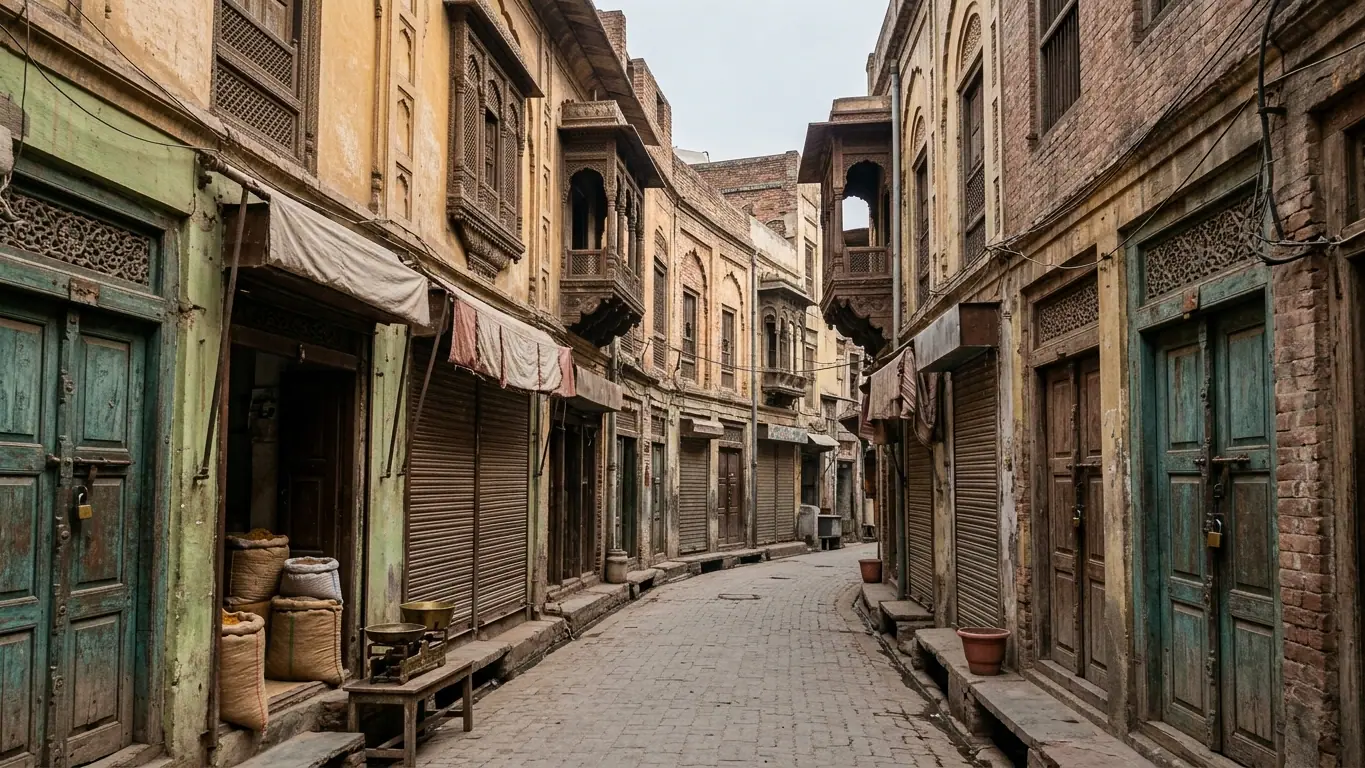
Heera Mandi, also called the Shahi Mohalla, is a neighbourhood and bazaar near Taxali Gate in Lahore’s Walled City, close to the Lahore Fort. The 2024 Netflix series Heeramandi is set here. Its name is traditionally linked to Hira Singh Dogra, a Sikh-era prime minister, and accounts place its origins in the Mughal period.
Where Heera Mandi is
Heera Mandi lies near Taxali Gate, close to the Lahore Fort and the Badshahi Mosque. Majid Sheikh, a Dawn columnist and local historian, calls the Shahi Mohalla the main bazaar of Taxali Gate, and Wikipedia places the area south of the Badshahi Mosque. Part of the old bazaar is now a food street.
The Walled City of Lahore Authority (now the Punjab Walled Cities & Heritage Areas Authority) says Taxali Gate is named after the Taxal, the Royal Mint, and was one of two gates built for entry to the Walled City from the west. It adds that neither the Mint nor the gate still exists. Old documents call the gate Shahi Taxal.
The name and its origins
Shahi Mohalla simply means the royal precinct. Heera Mandi is the name that accounts trace to Hira Singh Dogra, eldest son of Raja Dhian Singh, born in 1816. Text from the Encyclopaedia of Sikhism, reproduced by Pakistan Today, gives his term as prime minister of the Sikh kingdom of Lahore as 17 September 1843 to 21 December 1844, after Maharaja Ranjit Singh’s death.
The most commonly given account, as Sheikh tells it in Dawn in 2024, is that Hira Singh set up Lahore’s largest grain store in the Shahi Mohalla, called Heera Singh Di Mandi, and that the quarter took its name from it. Wikipedia and Pakistan Today give a similar account. Sheikh also says the bazaar was never officially given that name, and that the two names lived side by side.
Heera means diamond. Pakistan Today calls it a misconception that the word refers to the women entertainers who lived there, while Live History India says some believe that it does. Dawn describes the English name Diamond Market as a later coinage.
The Shahi Mohalla in history
Accounts place the quarter’s origin in the reign of the third Mughal emperor, Akbar, who ruled from 1556 to 1605. Sheikh wrote in 2016 that the Shahi Mohalla did not exist before 1575 and took its name because it was nearest to the royal quarters in the Lahore Fort. The same column says that the Punjabi Sufi poet Shah Hussain lived in the area, that the later poet Ustad Daman lived in his house, and that some of the leading Sikh military sardars built havelis in or near the precinct, some of which still stand.
Accounts describe the Mughal-era quarter’s women entertainers as trained artists, in the classical tradition of music and dance or in music, etiquette and dance. For the Sikh period, Live History India says Ranjit Singh reintroduced several royal customs of the Mughals in Lahore, among them the culture of the tawaifs, who were women entertainers, and their court performances.
Dawn and Louise Brown both record official action against prostitution in the quarter, and they date it differently. Dawn dates a ban to General Zia ul Haq’s time, in 1979. Brown, an academic, writes in her 2005 book The Dancing Girls of Lahore that Ayub Khan’s military government closed the red-light area in the 1960s, and that after a public outcry at least some of the women returned, officially restricted to singing and dancing at set times.
The series and the neighbourhood
The Netflix series Heeramandi: The Diamond Bazaar premiered on 1 May 2024. Wikipedia describes it as a drama about the tawaifs of Heera Mandi in Lahore, set against the Indian independence movement in the 1940s. Sheikh’s Dawn column of 12 May 2024 mentions protests in Lahore over the series allegedly being far removed from fact and reality.
Where the sources differ
The name is told differently. Sheikh’s 2024 column credits Hira Singh’s grain market. His 2016 column says Ranjit Singh renamed the place after his favourite general, whom it names as Heera Singh, while the Encyclopaedia of Sikhism text gives Hira Singh Dogra only as prime minister in 1843 and 1844. Live History India dates the market to after Ranjit Singh’s death in 1839. On the twentieth-century action, Dawn dates a ban to 1979 and Brown a closure to the 1960s.
For the history of another nearby Walled City landmark, see the article on Bhati Gate.
Visiting the area respectfully
People live and work here. Ask before photographing anyone, and keep to the public streets. Wikipedia notes that the words Heera Mandi are themselves considered offensive in informal conversation, so it is best to use the name with care.
The Walled City of Lahore Authority lists a guided Tales of Taxali tour that gathers at Fort Road Food Street. Its page lists stops including Taxali Gate, Bethak Ustaad Daman, Sheikhupurian Bazaar, the House of Sir Ganga Ram and Haveli Barood Khana. Check the page for dates, time and price.
For the wider Walled City, see the Walled City guide. Fakir Khana Museum stands elsewhere in the Walled City, inside Bhati Gate. Visits are by appointment. Call or write to arrange one. See Plan your visit.
Frequently Asked Questions
Where is Heera Mandi in Lahore?
Heera Mandi, also called the Shahi Mohalla, is a neighbourhood and bazaar near Taxali Gate in the Walled City of Lahore, close to the Lahore Fort and the Badshahi Mosque. Dawn’s Majid Sheikh calls the Shahi Mohalla the main bazaar of Taxali Gate, and Wikipedia places it south of the Badshahi Mosque.
How did Heera Mandi get its name?
The name is traditionally linked to Hira Singh Dogra, prime minister of the Sikh kingdom of Lahore in 1843 and 1844. Dawn’s Majid Sheikh wrote in 2024 that he set up Lahore’s largest grain store in the Shahi Mohalla, called Heera Singh Di Mandi. Accounts differ on the details; Pakistan Today calls it a misconception that heera refers to the women who lived there.
What does Shahi Mohalla mean?
Shahi Mohalla simply means the royal precinct. Dawn’s Majid Sheikh wrote in 2016 that the place took the name because it was nearest to the royal quarters in the Lahore Fort, and that it did not exist before 1575. Accounts place its origin in Akbar’s reign.
Is there a guided tour of the Taxali Gate area?
The Walled City of Lahore Authority lists a guided Tales of Taxali tour that gathers at Fort Road Food Street; check its page for dates, time and price. People live and work in the area, so ask before photographing anyone and keep to the public streets.
Sources and Further Reading
- Dawn: Majid Sheikh’s column of 6 March 2016 — Meaning of Shahi Mohalla, Taxali Gate bazaar, 1575, Sikh sardars’ havelis, the 2016 naming account, the 1979 ban and Shah Hussain and Ustad Daman
- Dawn: Majid Sheikh’s column of 12 May 2024 — Heera Singh Di Mandi grain store, the two names side by side, classical training, the Diamond Market coinage, the food street and protests over the series
- Wikipedia: Heera Mandi — Location south of the Badshahi Mosque, the grain-market account and the informal connotation of the name
- Pakistan Today: Heera Singh’s Mandi (23 April 2017) — Hira Singh Dogra’s dates, the grain-market account and the diamond misconception
- All About Sikhs: Hira Singh Dogra — Hira Singh Dogra’s parentage, birth year and term as prime minister
- Live History India: Heera Mandi — Training in music, etiquette and dance, Ranjit Singh and Mughal court customs, the market dated to after 1839 and the belief about the word heera
- Walled City of Lahore Authority: Gates — Taxali Gate as one of two western gates, its name from the Taxal (Royal Mint), and the loss of Mint and gate
- Walled City of Lahore Authority: The Tales of Taxali tour — The guided Tales of Taxali tour from Fort Road Food Street
- Walled City of Lahore Authority: About — The Authority’s current name