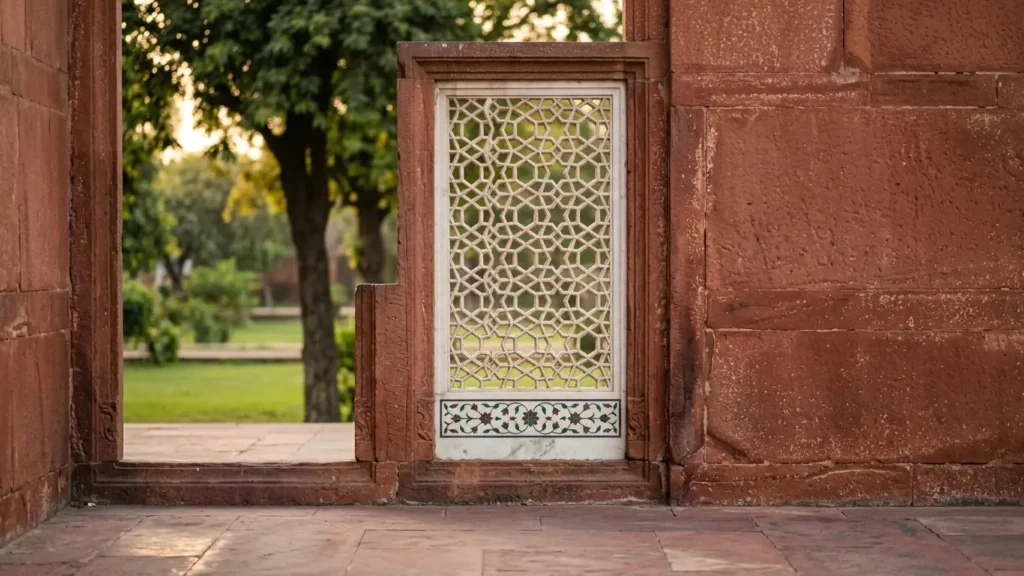

Allama Iqbal’s tomb stands in Hazuri Bagh, the garden between Lahore Fort and the Badshahi Mosque. A committee formed soon after his death in April 1938 refused money from the government and from princely rulers, and raised the funds from his friends, disciples and admirers. The government’s heritage listing dates the red sandstone tomb to 1951.
Where the tomb stands
The tomb stands in the south-west corner of Hazuri Bagh, in the shadow of the Badshahi Mosque’s high minaret, according to the Department of Archaeology and Museums. The garden lies between Lahore Fort and the mosque. The Walled City of Lahore Authority also places the samadhi of Ranjit Singh in the garden.
Iqbal was born in Sialkot on 9 November 1877 and died in Lahore on 21 April 1938. His birth anniversary, Allama Iqbal Day, is listed as a public holiday on Monday 9 November 2026 in the Cabinet Secretariat’s 2026 notification, as reported by Daily Pakistan.
Building the mausoleum
Dawn’s Majid Sheikh writes that after Iqbal’s death a decision was taken, with British approval, to bury him outside the Badshahi Mosque, given his popularity among the Muslims of Lahore.
The Iqbal Tomb Committee was headed by Chaudhary Muhammad Husain. Dawn reports that it did not like any of the eight proposals submitted by architects and asked Nawab Zain Yar Bahadar, chief architect of Hyderabad Deccan, to design the mausoleum.
The committee refused money from the government and from princely rulers. The funds came from Iqbal’s friends, disciples and admirers. Dawn adds that a Tomb Fund was set up and that relatively poorer residents of Lahore’s old Walled City went door to door collecting donations.
The builders used red stone from Jaipur and marble from Makrana. After Partition, Indian restrictions on the export of red stone caused a lull in the work. The government’s heritage listing dates the finished tomb to 1951. Later, the Associated Press of Pakistan reported an upgrade project at the mausoleum, with new tiles and marble in the exterior corridor and the interior renovation complete.
The headstone is said to be a gift from Afghanistan. The Lahore district government page records that earth collected from the tomb of Jalal ad-Din Muhammad Rumi is said to have been sent from Turkey to be sprinkled on the grave.
Hazuri Bagh and its Sikh-era origins
Hazuri Bagh was laid out in Ranjit Singh’s time. According to Live History India, he used the garden, next to Lahore Fort, as his summer residence, and his foreign minister and confidant Fakir Azizuddin supervised its building.
Azizuddin was the eldest of the three Fakir brothers and died in Lahore on 3 December 1845. You can read more about him and his brothers on the family page.
Guards and ceremonies
The Lahore district government page says that thousands of visitors come to the mausoleum every day. Guards of the Government of Pakistan are posted at the tomb, and the guard is changed in a ceremony on national occasions such as Iqbal Day and Independence Day. The forces taking part vary: on 9 November 2024, the 147th anniversary of Iqbal’s birth, contingents of the Pakistan Rangers and Pakistan Navy took charge of guard duty.
Access arrangements around Hazuri Bagh have changed over the years, so check the position locally before you travel.
From Hazuri Bagh to Bhati Gate
The Walled City of Lahore Authority lists Fakir Khana Museum and the old house where Iqbal lived while completing his graduation among the attractions near Bhati Gate. Guided walks linked to the authority have included both.
Fakir Khana is about 500 metres inside Bhati Gate on the right-hand side, roughly five minutes on foot from the gate at an easy pace. Visits are by appointment. Call or write to arrange one. Please ask about admission when you arrange your visit. Please ask before taking photographs.
Where the sources differ
Accounts of the design differ. Dawn says the committee agreed on Moorish and Afghan elements, then deadlocked over subcontinental features. Wikipedia calls the tomb mainly Mughal. On the Afghan gift, the heritage listing describes marble from the Afghan government, Dawn lapis lazuli from the Afghan government, and Wikipedia a lapis lazuli tombstone from the people of Afghanistan. The Walled City of Lahore Authority dates Hazuri Bagh to 1813, Live History India to 1818.
Plan your visit to Fakir Khana Museum inside Bhati Gate.
For more on Iqbal’s connections to the Walled City, read about his house near Bhati Gate.
Frequently Asked Questions
Where is Allama Iqbal’s tomb and when was it completed?
Allama Iqbal’s tomb stands in Hazuri Bagh, the garden between Lahore Fort and the Badshahi Mosque. The Department of Archaeology and Museums places it in the south-west corner of the garden, in the shadow of the mosque’s high minaret, and its heritage listing dates the red sandstone tomb to 1951.
Who designed and paid for the tomb of Allama Iqbal?
Dawn reports that the Iqbal Tomb Committee, headed by Chaudhary Muhammad Husain, did not like any of eight proposals from architects and asked Nawab Zain Yar Bahadar, chief architect of Hyderabad Deccan, to design it. The committee refused money from the government and from princely rulers, and the funds came from Iqbal’s friends, disciples and admirers.
How is Fakir Azizuddin connected to Hazuri Bagh?
Live History India records that Maharaja Ranjit Singh’s foreign minister and confidant Fakir Azizuddin, the eldest of the three Fakir brothers, supervised the building of Hazuri Bagh. The Walled City of Lahore Authority dates the garden to 1813, while Live History India dates it to 1818.
What should I know before visiting the tomb and Fakir Khana?
Access arrangements around Hazuri Bagh have changed over the years, so check the position locally before you travel. Fakir Khana Museum is about 500 metres inside Bhati Gate on the right-hand side. Visits are by appointment. Call or write to arrange one. Please ask about admission when you arrange your visit.
Sources and Further Reading
- Department of Archaeology and Museums: Tomb of Dr. Muhammad Iqbal — The tomb’s position in the south-west corner of Hazuri Bagh, its red sandstone and 1951 date, and the Afghan gift of marble.
- Dawn (Majid Sheikh): Harking Back, Designing the mausoleum of Allama Iqbal — The burial decision, the Iqbal Tomb Committee, the eight proposals, the architect, the Tomb Fund, the stone and the Afghan gift.
- Wikipedia: Tomb of Allama Iqbal — The committee formed in April 1938, the Mughal style and the lapis lazuli tombstone.
- Walled City of Lahore Authority: Gates of the Walled City — The garden’s contents, Hazuri Bagh dated to 1813, and the attractions near Bhati Gate including Iqbal’s house and Fakir Khana.
- Live History India: Ranjit Singh’s Lahore — Hazuri Bagh as Ranjit Singh’s summer residence, dated to 1818 and supervised by Fakir Azizuddin.
- ARY News: Change of guards ceremony at Allama Iqbal’s mausoleum — The change of guard on 9 November 2024 and Iqbal’s birthplace.
- Daily Pakistan: Public holidays in Pakistan 2026 — Allama Iqbal Day listed as a public holiday on Monday 9 November 2026.
- Daily Pakistan: Exploring the treasures of old Lahore at Fakir Khana Museum — Fakir Khana’s position about 500 metres inside Bhati Gate on the right-hand side.