Ten objects and rooms are worth asking about at Fakir Khana Museum, from a miniature said to have taken fifteen years to the Gol Kamra, the porcelain and the Gandhara heads. Ask which can be seen when you arrange your visit.
1. The single-hair portrait of Nawab Mumtaz Ali Khan
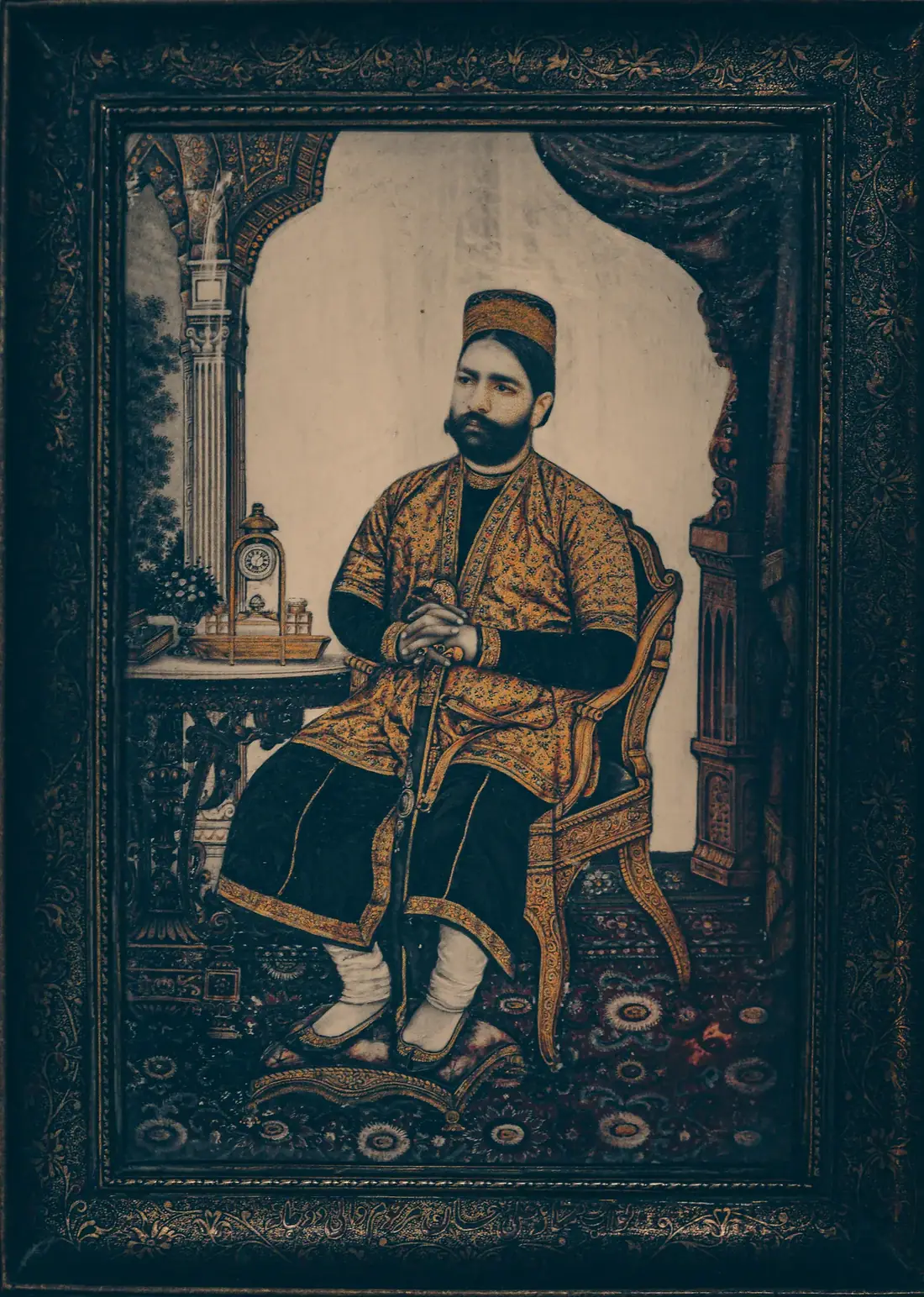
The museum dates Portrait of Nawab Mumtaz Ali Khan to the 19th century and calls it its masterpiece. The painting is traditionally said to have taken fifteen years, using a brush of a single hair. Reports from 2012 and 2018 say visitors have been offered a magnifying glass.
2. The shawl linked to Maharani Jind Kaur
The museum describes a fine Kashmiri pashmina shawl with very fine cut work and embroidery, believed to have belonged to Maharani Jind Kaur (1817 to 1863), the wife of Maharaja Ranjit Singh and the mother of Maharaja Duleep Singh. Its online record says she presented the shawl herself to a member of the Fakir family.
3. The jamawar robe linked to Maharaja Ranjit Singh
The museum’s record calls it a handmade Kashmiri jamawar, a robe of honour that Maharaja Ranjit Singh presented to the Fakir family, and gives its weight as about 4.5 kilograms. In the museum photograph it lies flat: long-sleeved, closed at the front on a diagonal, in dense paisley-patterned cloth of rust and brown tones with gold, lined in magenta at the cuffs and hem. The Encyclopedia of India describes jamawar as lengths of shawl fabric in all-over designs, intended to be tailored into men’s coats called jama.
4. The carpet catalogued as Shah Jahan-era
The museum catalogues it as a Mughal carpet from Shah Jahan’s weaving factory in Lahore and gives the date 1638. It also calls it The General’s Carpet. In the museum’s text, flowers, vases and birds appear first, and a human face woven into the design also becomes evident. Lahore had imperial carpet workshops in the 17th century, according to the Lahore Museum and a Qatar Museums catalogue.
5. The Gol Kamra, or Hall of Carpets
The Gol Kamra was originally the sitting room of the house, and the museum now calls it the Hall of Carpets. The Friday Times described it in 2018 as the main living room. The museum says it holds carpets, wall hangings, carved mantelpieces and metal ornaments in what it calls a quasi-antique setting of the early 19th century.
6. The Ladies’ Court of Shah Jahan
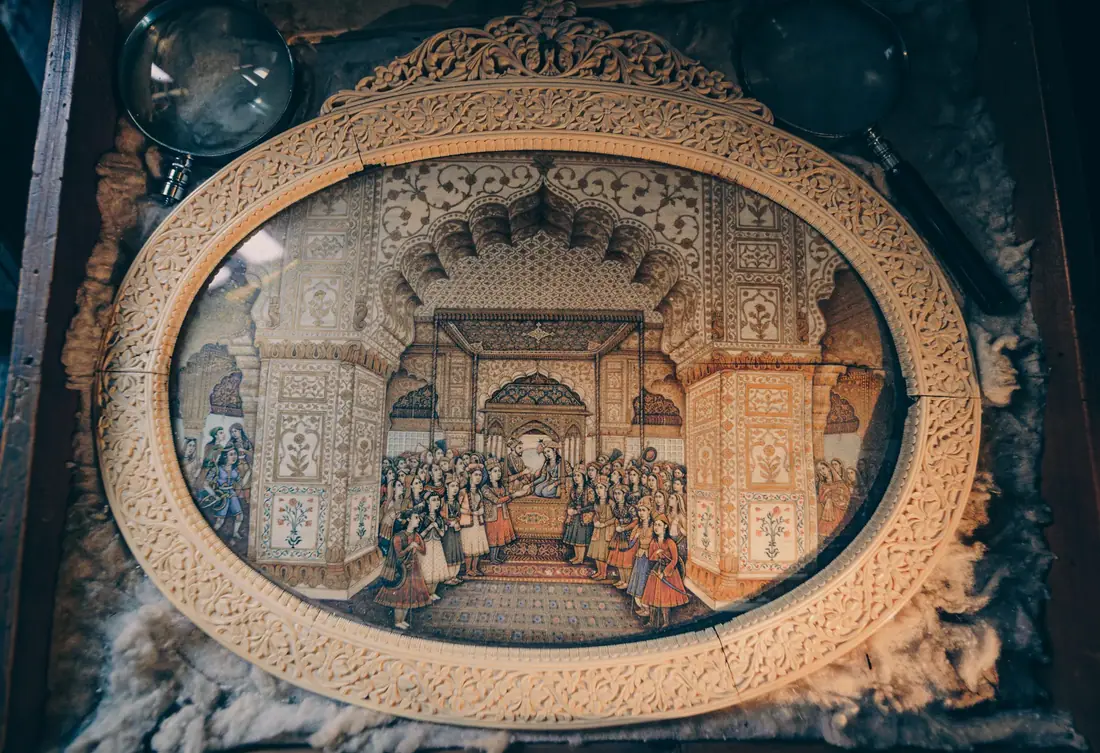
The museum titles the painting The Ladies’ Court of Shah Jehan, and its Google Arts & Culture exhibit calls it the zenana, or female, court. The online description says it is painted on a single piece of ivory, with gold and precious and semi-precious stone colours, and shows 42 figures besides the king and the queen. In the museum photograph an oval picture sits in a pale, finely carved oval frame with floral scrolls. A canopied throne stands under scalloped arches, with a man and a woman at its centre, crowds of standing figures around them and a group in blue at the left.
7. Porcelain the museum lists from eight countries
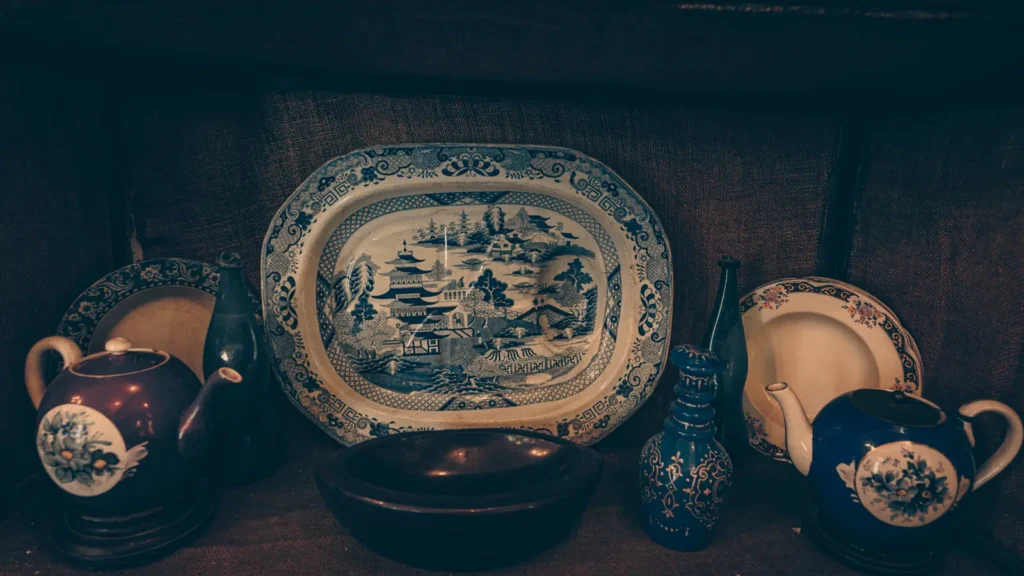
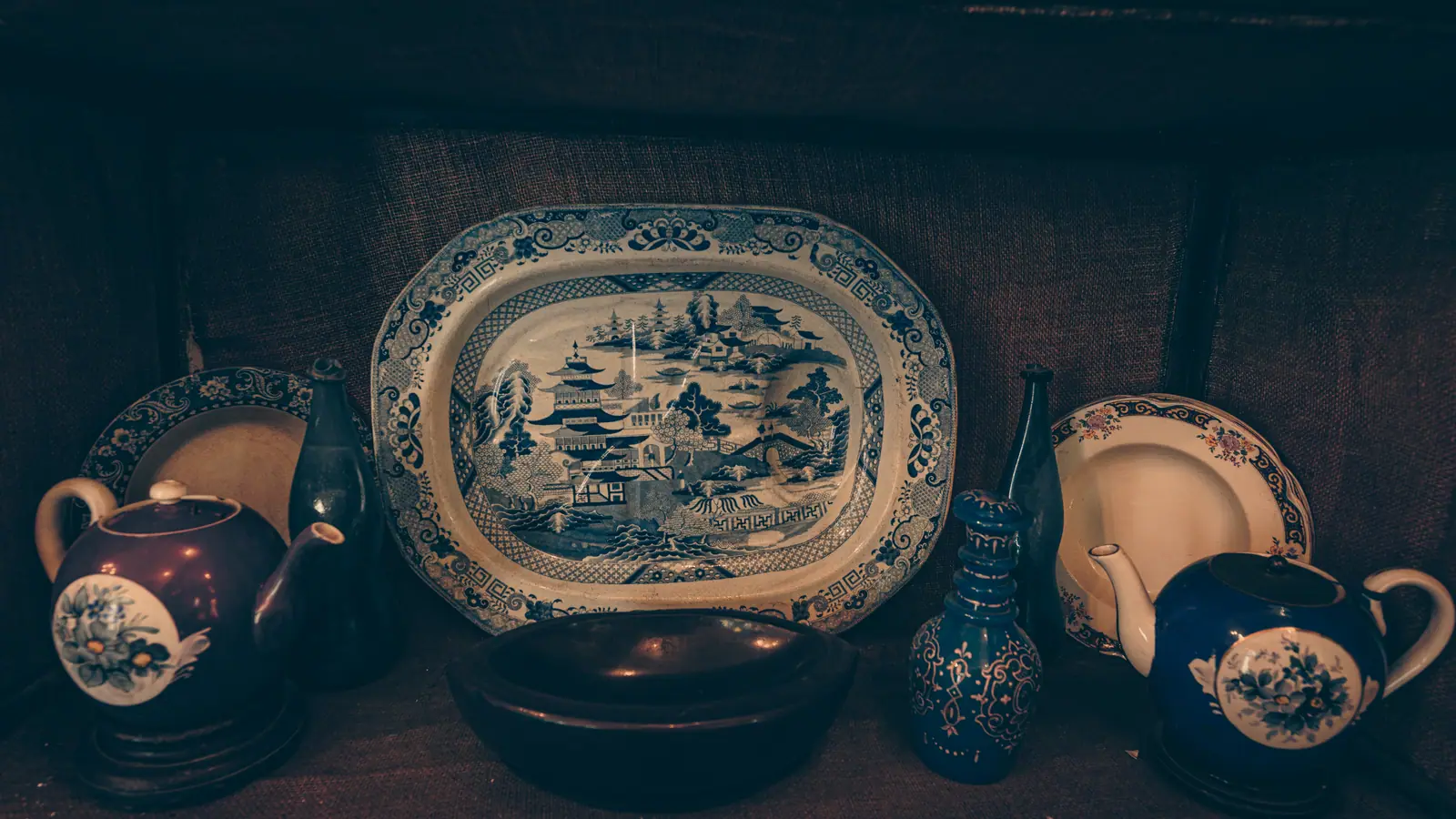
The museum’s text says its porcelain comprises old Chinese, Japanese, Korean, Russian, French, German, English and Dutch crockery. Gulf News reported seeing Chinese, Japanese, Russian and French porcelain and celadon crockery in 2018. A 2017 visitor account also describes a wooden kettle with Chinese characters carved on it.
8. Gandhara sculpture
The museum describes Three heads of Gandhara as a 4th-century sculpture of the Buddha showing three phases of his life. In the museum photograph it is a tapering stone block carved with three stacked faces, with bulging, spiral-marked eyes and broad noses, framed by coiling serpent-like forms on black cloth. The museum catalogues a second piece, Flowers Showering, Buddha’s Mouth, as soapstone Gandhara work of the 3rd century, originally from the Chakwal Valley. The museum’s text adds that Gandhara art reached its peak between the 1st and 5th centuries.
9. The agate medicine grinder
The museum’s description says the grinder is made of one single piece of agate, originally from Iran. In the museum photograph it is a shallow, smooth oval bowl with a rounded rim, reddish-brown and polished, on a dark ground.
10. The Sikh shield
The family’s photograph archive labels this object a shield of the Sikh period. In the museum photograph the rim carries a gold-inlaid frieze of figures and animals, including a kneeling figure striking at a lion, and the centre has a leafy floral pattern with a metal boss. Published accounts of the museum also mention Sikh-period arms.
Where the sources differ
Accounts differ on who painted the Mumtaz Ali Khan portrait and on what it is painted on. Gulf News and Google Arts & Culture name Ghulam Ali, and Google Arts & Culture says ivory; other accounts give an unknown maker and paper. They also differ on the robe. The museum’s record calls it a robe of honour Ranjit Singh gave to the Fakir family. Its director, pointing to a sash, ribbon, robe and shawl in 2018, told Gulf News “These are all his personal belongings”, meaning Ranjit Singh’s.
Arranging a visit
Visits are by appointment. Call or write to arrange one. Please do not touch the objects. Please ask before taking photographs. Your guide will tell you what is possible. The collection can be browsed online before you go.
Frequently Asked Questions
What is the single-hair portrait at Fakir Khana Museum?
It is the Portrait of Nawab Mumtaz Ali Khan, which the museum dates to the 19th century and calls its masterpiece. The painting is traditionally said to have taken fifteen years, using a brush of a single hair. Accounts differ on who painted it and on whether it is on paper or ivory.
Which textiles linked to the Sikh court does the museum describe?
The museum describes a Kashmiri pashmina shawl it believes belonged to Maharani Jind Kaur, and a jamawar robe that its record calls a robe of honour presented to the Fakir family by Maharaja Ranjit Singh. The shawl’s online record says the Maharani presented it herself to a member of the Fakir family.
What is the Gol Kamra at Fakir Khana Museum?
The Gol Kamra was originally the sitting room of the house and is now called the Hall of Carpets. The museum says it holds carpets, wall hangings, carved mantelpieces and metal ornaments in what it calls a quasi-antique setting of the early 19th century.
What porcelain does Fakir Khana Museum describe?
The museum’s text lists old Chinese, Japanese, Korean, Russian, French, German, English and Dutch crockery. Gulf News reported seeing Chinese, Japanese, Russian and French porcelain and celadon crockery in 2018, and a 2017 visitor account describes a wooden kettle with Chinese characters carved on it.
Can I see all ten highlights on one visit?
Which of these can be seen on a given visit is something to ask when you arrange it. Visits are by appointment. Call or write to arrange one. Your guide will tell you what is possible.
Sources and Further Reading
- Fakir Khana Museum story – Google Arts & Culture — The museum’s account of the shawl, the carpet, the Gol Kamra and Hall of Carpets, the porcelain and Gandhara art.
- Handmade Jamawar Robe, Maharajah Ranjit Singh – Google Arts & Culture — The museum’s record of the robe of honour and its weight.
- The Ladies’ Court of Shah Jehan – Google Arts & Culture — The museum’s description of the ivory support, the colours and the 42 figures.
- Agate Medicine Grinder – Google Arts & Culture — The museum’s description of the single piece of agate from Iran.
- Three heads of Gandhara – Google Arts & Culture — The museum’s description of the 4th-century sculpture.
- A museum is witness to Lahore’s past – Gulf News (2018) — The magnifying glass, the porcelain seen in 2018 and the director’s remark on the robe.
- Kashmir shawls – Encyclopedia of India — The definition of jamawar as shawl fabric intended to be tailored into men’s coats.
- Heer Waris Shah in six volumes – APNA (Youlin, 2017) — A 2017 visit account: the wooden kettle with Chinese characters and Sikh-period armour on the wall.