Fakir Khana Museum in Lahore dates its portrait of Nawab Mumtaz Ali Khan to the 19th century and calls it its masterpiece. The portrait is traditionally said to have taken fifteen years to paint, with a brush of a single hair. The museum gives its size as about 12 by 6 inches.
The portrait and its sitter
The museum names the sitter as Nawab Mumtaz Ali Khan. In the museum’s photograph he is a bearded man in a gold-patterned orange-brown cap and a knee-length coat with gold patterning over dark garments, seated in a carved armchair with his hands folded over a slender, cane-like object. At the left of the picture a small table holds a clock and glass bottles on a tray; a fluted column and a tree show behind him, with a curtain at the right and a patterned carpet beneath his feet. The picture sits in a dark frame with gilt floral ornament, and a line of gilt writing in Arabic script runs along the lower border of the frame.
Fifteen years and one hair: the tradition
The museum records a tradition that the portrait was painted over fifteen years with a brush of a single hair. Two visiting reporters were told the fifteen years: ISIS Magazine in 2012 by the museum’s curator, and Gulf News in 2018 by the museum’s director, who also described a single-hair brush. For context on the materials and tools used by miniature painters, see the museum’s glossary of miniature painting techniques.
Who painted it?
The museum records the maker as unknown. Google Arts & Culture and Gulf News name the painter as Ghulam Ali, and Gulf News calls him a famous painter in the court of the last Mughal emperor, Bahadur Shah Zafar.
The museum’s director told Gulf News that Ghulam Ali made the portrait, using a single-hair brush, when Bahadur Shah Zafar went into exile. The emperor was exiled to Rangoon after the rising of 1857.
How miniaturists painted fine detail
None of these passages is about this portrait; they describe the craft in general. An essay from Brown University’s Minassian Collection says Mughal artists favoured brushes made from the downy fur of a common type of squirrel. Amelie Couvrat Desvergnes, a conservator at the Wereldmuseum in Leiden, writes that Pahari painters of the 17th to 19th centuries used brushes of squirrel-tail hair for very thin details such as facial features. ISIS Magazine reported in 2012 that painters at the National College of Art in Lahore use squirrel-hair brushes with two or three hairs in the tip to layer detail, a modern studio brush that differs from the single hair of the museum’s tradition.
Looking through the magnifying glass
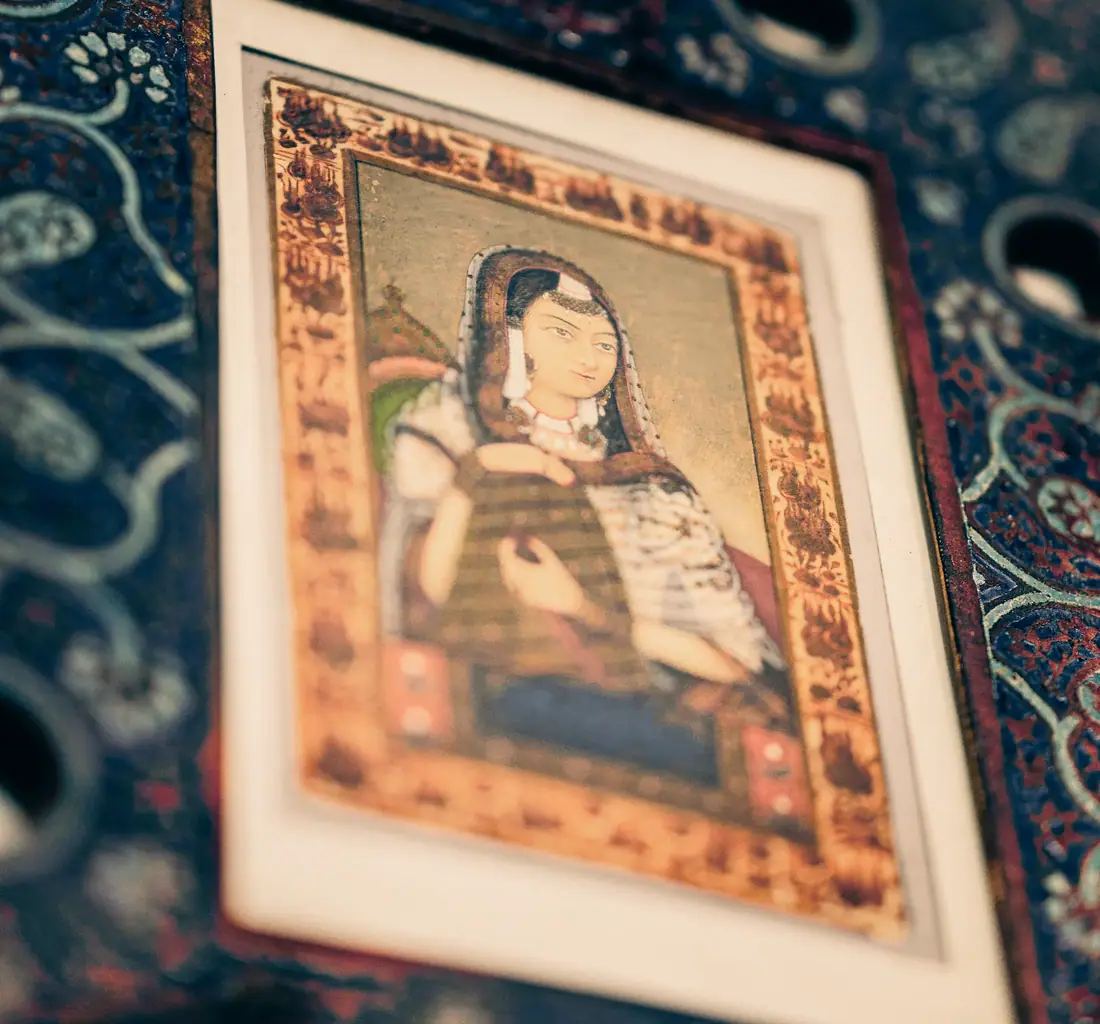
Gulf News reported in 2018 that a magnifying glass was kept nearby for visitors, and ISIS Magazine in 2012 called one the only way to appreciate the work. The museum’s director pointed Gulf News to the sitter’s eyebrows and eyelashes, the workmanship on his cap and the embroidery. The ISIS Magazine reporter noted downy hairs around the man’s temples and delicate veins, and gold leaf worked to look like threads in a carpet.

Visits to Fakir Khana Museum are by appointment. Call or write to arrange one through the Visit page, and ask when you arrange your visit whether the portrait is on view. Please ask before taking photographs.
Where the sources differ
Google Arts & Culture describes the portrait as made on ivory, while the museum’s own collection listing gives opaque watercolour on paper. The museum names the sitter as Nawab Mumtaz Ali Khan, and ISIS Magazine in 2012 described him as ruler of the state of Dijana. The museum gives the size as about 12 by 6 inches, and ISIS Magazine called the work postcard-sized.
Explore the collection.
Frequently Asked Questions
How long is the portrait of Nawab Mumtaz Ali Khan said to have taken?
The museum’s tradition holds that the portrait was painted over fifteen years with a brush of a single hair. The museum’s curator gave the fifteen years to ISIS Magazine in 2012, and its director repeated them to Gulf News in 2018, adding the single-hair brush.
Who painted the portrait of Nawab Mumtaz Ali Khan at Fakir Khana?
The museum records the maker as unknown, while Google Arts & Culture and a 2018 Gulf News report name the painter as Ghulam Ali. The museum’s director told Gulf News that Ghulam Ali painted it when the last Mughal emperor, Bahadur Shah Zafar, went into exile.
Is the portrait of Nawab Mumtaz Ali Khan painted on ivory or paper?
Descriptions differ. Google Arts & Culture describes the portrait as made on ivory, while the museum’s own collection listing gives opaque watercolour on paper. The museum gives its size as about 12 by 6 inches.
Can visitors see the single-hair miniature with a magnifying glass?
Visitors have been offered a magnifying glass to study the portrait, according to reports from 2012 in ISIS Magazine and 2018 in Gulf News. Ask when you arrange your visit whether the portrait is on view. Visits to Fakir Khana Museum are by appointment; call or write to arrange one.
Sources and Further Reading
- Portrait of Nawab Mumtaz Ali Khan, Google Arts & Culture — The museum-supplied object page: sitter, period, ivory, Ghulam Ali and the fifteen-year, single-hair tradition
- Gulf News: A museum is witness to Lahore’s rich past (2018) — The director on the fifteen years, the single-hair brush, Ghulam Ali and the emperor’s exile, and the magnifying glass
- ISIS Magazine: Why big is small in Pakistan (15 November 2012) — The curator’s fifteen years, the magnifying glass, the sitter’s description and brushes at the National College of Art
- Production of a Miniature Painting, Brown University Minassian Collection — Mughal squirrel-fur brushes
- Pahari Paintings, Wereldmuseum — A conservator on Pahari painters’ brushes, including squirrel-tail hair for thin details
- Bahadur Shah II, Wikipedia — Context: the last Mughal emperor was exiled to Rangoon after the 1857 rising