A Kashmiri pashmina shawl is woven from pashm, the soft undercoat of goats herded on the high plateaus of Tibet and Ladakh. The West calls the same fibre cashmere. It is generally finer than sheep’s wool, though the ranges overlap, so the fibre content on a label says more than the word pashmina.
What pashmina is, and how it differs from cashmere
The raw material of the Kashmir shawl is called pashm in India, and the cloth woven from it is pashmina. According to Janet Rizvi in the Encyclopedia of India, pashm is the warm, soft undercoat of goats herded on the high-altitude plateaus of Tibet and Ladakh, combed out by their herders at the onset of summer. Britannica describes cashmere in the same terms, as the downy undercoat of the Kashmir goat, and adds that only the product of the Kashmir goat is true cashmere.
The US Federal Trade Commission, in business guidance dated July 2014, says experts tell it that no pashmina fibre is separate and distinct from cashmere, and it calls pashmina an Indian word for cashmere. It adds that some sellers use the word for ultra-fine cashmere and others for a blend of cashmere and silk. In a shop, the fibre content on the label therefore tells you more than the word pashmina.
Rizvi also describes a different material, toosh, from the Tibetan antelope, or chiru, used for the very finest shawls. Wild chiru are killed to obtain it, she writes; the species is endangered and trade in its products is banned.
Pashmina and fine wool compared
Britannica gives sheep’s wool diameters of about 16 to 40 microns and says wool is mainly obtained by shearing fleece from living animals. Most cashmere down, by contrast, is plucked or combed out by hand during the moulting season, though Iranian cashmere is obtained by shearing.
Britannica says cashmere fibres are finer than those of the best wools: 14.5 to 16.5 microns for goats of China and Mongolia, and 17.5 to 19.5 for Iranian goats. These are figures for cashmere from China, Mongolia and Iran, not for fibre from Ladakh. Cashmere is generally finer than sheep’s wool, but the ranges overlap, and the FTC notes that some sheep produce ultra-fine fibres comparable in diameter to cashmere. Width alone does not identify the fibre.
Yields are small. Britannica gives the annual yield per goat as a few grams to about 0.5 kilogram, and says processing removes coarse hairs and cuts the yield by about 50 per cent. A cashmere sweater needs the fleece of 4 to 6 goats and an overcoat 30 to 40.
How a Kashmir shawl was made
In the nineteenth century, women removed the coarse outer hairs, cleaned the fleece with rice-flour paste and spun it on wheels, a skill passed down from mother to daughter. The classic Kashmir shawl was woven in a twill weave called kani, or tilikar in Kashmir, in which the crosswise threads, the weft, are put in by small bobbins instead of a shuttle. The museum’s guide to jamawar cloth explains how weavers used this technique to create patterned textiles. Rizvi writes that by the mid-nineteenth century particularly fine shawls took months and even years to complete. A 2020 feature in The Tribune, an Indian newspaper, puts a kani shawl in early nineteenth-century Kashmir at up to 18 months or more.
What labels say in the United States
The rules reported here are United States rules. Under them, pashmina is not a labelling term recognised by the Wool Act and its regulations, so an item cannot be labelled 100% Pashmina. A piece that contains only cashmere should be labelled 100% Cashmere or All Cashmere, and a blend states its fibres, such as 70% Cashmere, 30% Silk. The word cashmere on a US label carries conditions, among them that the fibre is the fine dehaired undercoat of a Cashmere goat and that its average diameter does not exceed 19 microns.
The FTC’s guidance is addressed to people who make or sell wool products. It says a trained expert using an optical or electron microscope can tell cashmere from sheep’s wool by the scale structure of the fibres, and it advises routine testing by a qualified independent laboratory. No simple test by touch or sight is established.
Historic pashmina in Lahore
Rizvi writes that under Afghan, Sikh and Dogra rule heavy taxes fell on the shawl industry, and that weavers who could escape emigrated to the Punjab and elsewhere in North India. The Tribune says Kashmir became part of the Sikh kingdom in 1819 and that by 1835 Amritsar had become the centre of the Kashmiri shawl trade.
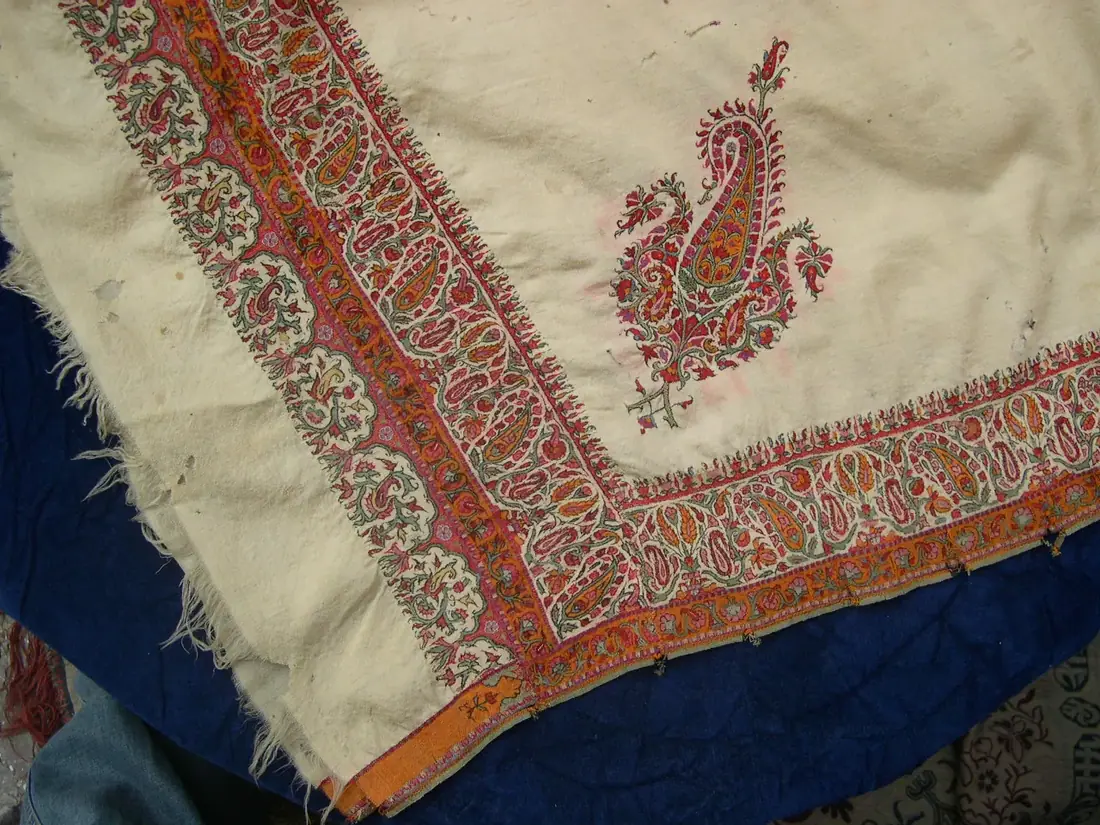
Fakir Khana Museum says its textiles belong almost entirely to the nineteenth-century Sikh period, and a highlight is a fine Kashmiri shawl. The museum believes the shawl belonged to Maharani Jind Kaur (1817 to 1863), wife of Maharaja Ranjit Singh and mother of Duleep Singh, the last Sikh sovereign of the Punjab, and says she presented it to Qamar ud-Din of the Fakir family. Its record describes the pashmina as having very fine cut work and embroidery and as wearable both ways. The shawl has its own article in the Chronicles: Maharani Jind Kaur’s shawl.
Visits are by appointment. Call or write to arrange one. Please ask about admission when you arrange your visit, and whether the shawl can be seen. You can also explore the collection.
Frequently Asked Questions
Is pashmina a different fibre from cashmere?
Janet Rizvi’s entry in the Encyclopedia of India calls the fibre pashm and the cloth woven from it pashmina, and says the West knows the fibre as cashmere. The US Federal Trade Commission says experts tell it there is no pashmina fibre separate from cashmere, and that some sellers use the word for ultra-fine cashmere and others for a cashmere and silk blend.
Can a shawl be labelled 100% Pashmina in the United States?
No. The US Federal Trade Commission says an item cannot be labelled 100% Pashmina, because pashmina is not a fibre recognised by the Wool Act or its regulations. A piece containing only cashmere should be labelled 100% Cashmere or All Cashmere, and a blend states its percentages, such as 70% Cashmere, 30% Silk.
How does the fibre diameter of cashmere compare with sheep’s wool?
Britannica gives 14.5 to 16.5 microns for cashmere from goats of China and Mongolia and 17.5 to 19.5 for Iranian goats, against about 16 to 40 microns for sheep’s wool. The ranges overlap, and some sheep produce ultra-fine fibres comparable in diameter to cashmere, according to the US Federal Trade Commission. These are not figures for fibre from Ladakh.
How is the fibre in a shawl tested?
The US Federal Trade Commission, writing for people who make or sell wool products, says a trained expert using an optical or electron microscope can tell cashmere from sheep’s wool by the scale structure of the fibres, and it advises routine testing by a qualified independent laboratory. No simple test by touch or sight is established.
Sources and Further Reading
- Kashmir Shawls, Encyclopedia of India (Janet Rizvi) — Pashm and pashmina, the high-plateau goat undercoat, toosh and the chiru trade ban, nineteenth-century spinning and kani weaving, and the Punjab emigration of weavers.
- Cashmere, Encyclopaedia Britannica — Kashmir goat undercoat, hand-combing and shearing, yields, goats per sweater and overcoat, and fibre diameters for Chinese, Mongolian and Iranian cashmere.
- Wool, Encyclopaedia Britannica — Sheep’s wool diameter range of about 16 to 40 microns and shearing from living animals.
- Cachet of Cashmere: Complying with the Wool Products Labeling Act, US Federal Trade Commission (July 2014) — No separate pashmina fibre, pashmina not a US label term, cashmere label conditions, blend labelling examples and microscope testing.
- The Tribune (India), 2020 feature on the Kashmiri shawl trade in Amritsar — Up to 18 months for a kani shawl, Kashmir in the Sikh kingdom from 1819 and Amritsar as the centre of the shawl trade by 1835.
- Fakir Khana Museum story, Google Arts & Culture — The museum’s textile collection and the shawl it believes belonged to Maharani Jind Kaur.
- Shawl, Maharani Jindah, Fakir Khana Museum (Google Arts & Culture) — The museum’s description of its pashmina shawl and the account of its presentation to Qamar ud-Din.
- Encyclopaedia of Sikhism: Jind Kaur, Maharani (1817-1863) — Maharani Jind Kaur’s dates, her marriage to Maharaja Ranjit Singh and her son Maharaja Duleep Singh.