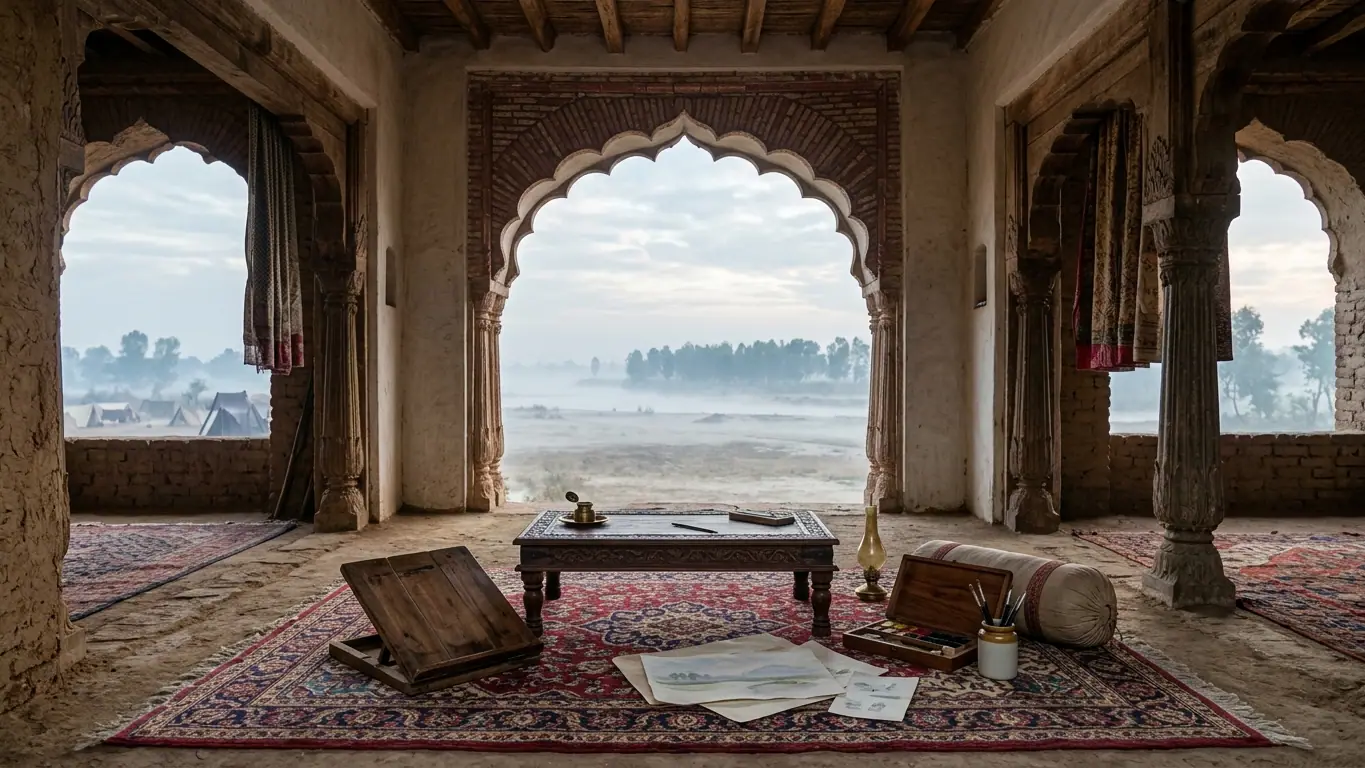
Emily Eden, an English writer and amateur artist, visited the court of Maharaja Ranjit Singh in late 1838 with her brother Lord Auckland, the Governor-General, and her sister Fanny. Her letters to her sister record what she saw of the Maharaja and his court. In one of them she names Fakir Azizuddin as his interpreter and adviser.
Who Emily Eden was
Emily Eden (3 March 1797 to 5 August 1869) went to India with her sister Fanny and their brother George Eden, Lord Auckland, who was Governor-General from 1836 to 1842. Between October 1837 and February 1840 the Edens toured Oudh and the hill regions, and in 1838 they visited Ranjit Singh’s court. Emily wrote journal-letters to her sister Mary Drummond. They were published in 1866 as Up the Country: Letters Written to Her Sister from the Upper Provinces of India.
The meetings of late 1838
Late in November 1838 the British Army of the Indus assembled at Ferozepore (Firozpur) on the Sutlej, and Lord Auckland met Ranjit Singh there at the end of the month. A few days later, on the evening of Monday 3 December, there was a party in the camp. The meetings continued at Amritsar, which Eden describes in a letter of 10 December, and at Lahore, where her entries run from about 17 December.
What she saw of the Maharaja
Writing of the first great meeting in the letter she began at the Ferozepore camp on 28 November, Eden noted that Ranjit Singh wore no jewels, only “the commonest red silk dress”. She adds that her picture of Queen Victoria in her coronation robes was carried in on a green and gold cushion and presented to him, and that he examined it for at least five minutes with his one eye. The text printed with the 1844 portrait of him after Eden remarks on his “perfect simplicity, or rather plainness of appearance” beside courtiers in brilliant draperies.
Her assessment of the Maharaja came in the Ferozepore letter of 3 December 1838, written home to her sister. She gave it as her opinion that he had “made himself a great king” and that “he is remarkably just in his government”. She also wrote that he talked “chiefly with his one eye and a few signs which his fakeer makes up into a long speech”. The 1844 text adds that when the likeness was taken he was partially paralysed and said few words, guiding his court mainly by signs.
Azizuddin the interpreter
The Encyclopaedia of Sikhism records that Fakir Azizuddin acted as the Maharaja’s interpreter during his meeting with Lord Auckland towards the end of 1838. Eden first names him in her entry for the evening of 3 December. As Ranjit Singh’s attendants knelt before him, she writes, one was “the Fakeer Uzeez-ood-deen, who is his interpreter and adviser and the comfort of his life”.
He was not the only person to relay the Maharaja’s words. In the same entry Eden records someone she identifies only as C. translating, “in his literal way”, a remark to Lord Auckland: “The Maharajah wishes your lordship would talk a little more friendship to him.”
Earlier, in a letter from Simla dated 7 May 1838, Eden described a Sikh deputation of six principal people, one of whom was “a fakeer who is Runjeet’s chief confidant and adviser, and a clever man”. She does not name him there, but the description fits the Fakir who later interpreted. At Lahore her entry for Christmas Day records the Maharaja as still ill with the fakeer in attendance, presumably the same man.
F.S. Aijazuddin, a member of the Fakir family, wrote a 2002 article on Azizuddin. It places him with Lord Auckland at Amritsar and later at Lahore in December 1838, and lists the sisters Emily and Fanny Eden among the visitors who left their impressions of him.
Her portraits of the court
Eden’s December entries from the Lahore camp record the sittings. In the entry headed Shalimar, Thursday 20 December, she writes that “Shere Singh came to my tent to sit for his picture”. The next day, at Lahore, Heera Singh also came to sit, though it was too dark to draw him well. On Sunday 23 December, after a review the afternoon before, she found “a quiet corner from which I could sketch Runjeet”.
After returning to England in 1842, Eden worked up her sketches and had them printed privately as 24 lithographs. They were published in 1844, in four parts, as Portraits of the Princes and People of India. The plate Horses and jewels of Runjeet Singh, published by J. Dickinson and Son in London, credits Lowes Cato Dickinson (1819 to 1908) as artist after Emily Eden, with lithography by C. Hullmandel.
Where the sources differ
Eden’s letter, begun at the Ferozepore camp on Wednesday 28 November 1838, has an entry headed Friday that says “Yesterday was the day of the great meeting”. That gives Thursday 29 November. The Encyclopaedia of Sikhism dates the meeting at Ferozepore to 30 November.
Read more about the Fakir family on the Family page and in the Chronicles.
For another perspective on how the Sikh court was depicted, see paintings of Maharaja Ranjit Singh’s darbar.
Frequently Asked Questions
When did Emily Eden meet Maharaja Ranjit Singh?
Emily Eden went with her brother Lord Auckland to the Ferozepore camp, where the first great meeting with Ranjit Singh took place at the end of November 1838. Her own letter places it on Thursday 29 November; the Encyclopaedia of Sikhism gives 30 November. Further meetings followed at Amritsar and Lahore in December.
What role did Fakir Azizuddin play in Lord Auckland’s 1838 meetings with Ranjit Singh?
The Encyclopaedia of Sikhism says Azizuddin acted as the Maharaja’s interpreter during his meeting with Lord Auckland towards the end of 1838. Emily Eden’s letter of 3 December 1838 names the Fakeer Uzeez-ood-deen and calls him the Maharaja’s interpreter and adviser. She also records another person, called only C., translating a remark that evening.
How did Emily Eden describe Maharaja Ranjit Singh?
Writing of the first great meeting at Ferozepore in late November 1838, Eden noted that he wore no jewels, only the commonest red silk dress. In her letter of 3 December 1838 she wrote that he had made himself a great king and that he was remarkably just in his government. These are one visitor’s impressions.
When were Emily Eden’s letters and portraits published?
Her journal-letters to her sister Mary Drummond were published in 1866 as Up the Country. After returning to England in 1842 she worked up her sketches, and 24 lithographs were printed privately and published in four parts in 1844 as Portraits of the Princes and People of India.
Sources and Further Reading
- Project Gutenberg: Up the Country, by the Hon. Emily Eden — Eden’s letters of 1837 to 1840, including the Simla letter of 7 May 1838 and the Ferozepore, Amritsar and Lahore entries of November and December 1838
- Bonhams: Maharajah Ranjit Singh, after Emily Eden (London, 1844) — The Edens’ tour, the 1844 publication of 24 lithographs in four parts, the 1866 date of Up the Country and the 1844 letterpress
- Wikipedia: Emily Eden — Eden’s life dates and her journey to India with her sister Fanny and brother Lord Auckland
- British Library: Horses and jewels of Runjeet Singh (1844) — Credits Lowes Cato Dickinson (1819 to 1908) after Emily Eden and C. Hullmandel’s lithography, published by J. Dickinson & Son, London, 1844
- F.S. Aijazuddin: Fakir Azizuddin article (2002) — Places Azizuddin with Lord Auckland at Amritsar and Lahore in December 1838 and lists the Eden sisters among visitors who recorded impressions of him
- Encyclopaedia of Sikhism (All About Sikhs): Faqir Aziz ud-Din — Azizuddin as the Maharaja’s interpreter during his meeting with Lord Auckland towards the end of 1838
- Encyclopaedia of Sikhism (All About Sikhs): George Eden, Lord Auckland — The assembly of the Army of the Indus at Firozpur in late November 1838 and the date of 30 November for the meeting there
- Wikipedia: George Eden, 1st Earl of Auckland — Lord Auckland’s term as Governor-General, 4 March 1836 to 28 February 1842