
Mughal miniature paintings are court pictures made in India under the Mughal emperors, who ruled from the sixteenth to the eighteenth century. Most began as illustrations for manuscripts, and some were single pages for albums. The style grew from Persian painting and took in Indian and European ideas. Fakir Khana Museum lists Mughal among its miniature traditions.
What makes a painting Mughal
The subjects were generally secular: illustrations to historical works and to Persian and Indian literature, portraits of the emperor and his court, studies of natural life, and genre scenes. Some works illustrate a Persian translation of the Hindu legend Harivamsa, commissioned by Akbar. The style was essentially a court art.
Under Akbar it took local elements, especially Rajput colour schemes, while keeping the upright format and flat aerial perspective of Persian painting.
From Persian roots to the imperial workshop
There is no historical evidence that Babur, who founded the dynasty in 1526, had court artists on official commissions. The Persian link came through his son Humayun. Displaced from his throne, Humayun took refuge at the Safavid court of Shah Tahmasp in Iran. When he regained the throne in 1555, several Persian artists, including Mir Sayyid Ali and Khwaja Abdus-Samad, went with him to India. Abdus-Samad became tutor to the young Akbar, and the early art of Akbar’s court had strong Safavid influences.
Akbar, who reigned from 1556 to 1605, assembled a royal atelier, first at Fatehpur Sikri and then at Lahore. From it he commissioned illustrated manuscripts with Persian and Indian elements and even some European ones. The Metropolitan Museum of Art notes that his artists included Persians as well as Indian Muslims and Hindus, and that this collaboration helped develop a specifically Mughal style, refined under Jahangir and Shah Jahan.
One large undertaking was the Dastan-i Amir Hamza, or Hamzanama. Britannica says Akbar commissioned its large miniatures possibly as early as 1562. Abdus-Samad and Mir Sayyid Ali led a team of about 100 painters, who took 15 years to produce some 1,400 large illustrations.
Pigments, brushes and burnishing
Mughal illustrations were mostly painted on cotton-fibre paper with fine brushes of soft animal hair. The painter began with a drawing in charcoal or ink, then built up colour in layers, often by different hands, with portraitists finishing the faces. The surface was burnished several times, with stone slabs and agate-tipped tools, to give a smooth, luminous finish.
Powdered pigments were bound with gum arabic. Blue came from lapis lazuli or indigo, red from vermilion or iron oxide, black from soot and yellow from orpiment, while green sometimes came from verdigris. Gold and silver were used as powders.
A University of the Punjab study of the traditional materials of miniature artists adds that painters prepared their own paper, pigments, pens and brushes. The support, called wasli, was four or eight layers of glued paper, depending on the size of the miniature, burnished with a smooth stone or a large seashell. Detail was done with a fine brush, ideally of squirrel’s tail hair, and gold was applied last.
Portraits, courts and albums
Under Jahangir, who ruled from 1605 to 1627, colours became more subdued and brushwork grew exceptionally fine. Portraiture gained a deeper insight into the character of sitters. Ustad Mansur is named for his animal and plant studies and Bishandas for his portraits. European engravings and paintings, acquired through diplomacy and Jesuit missions, led to new approaches to shading and perspective and to the rendering of volume.
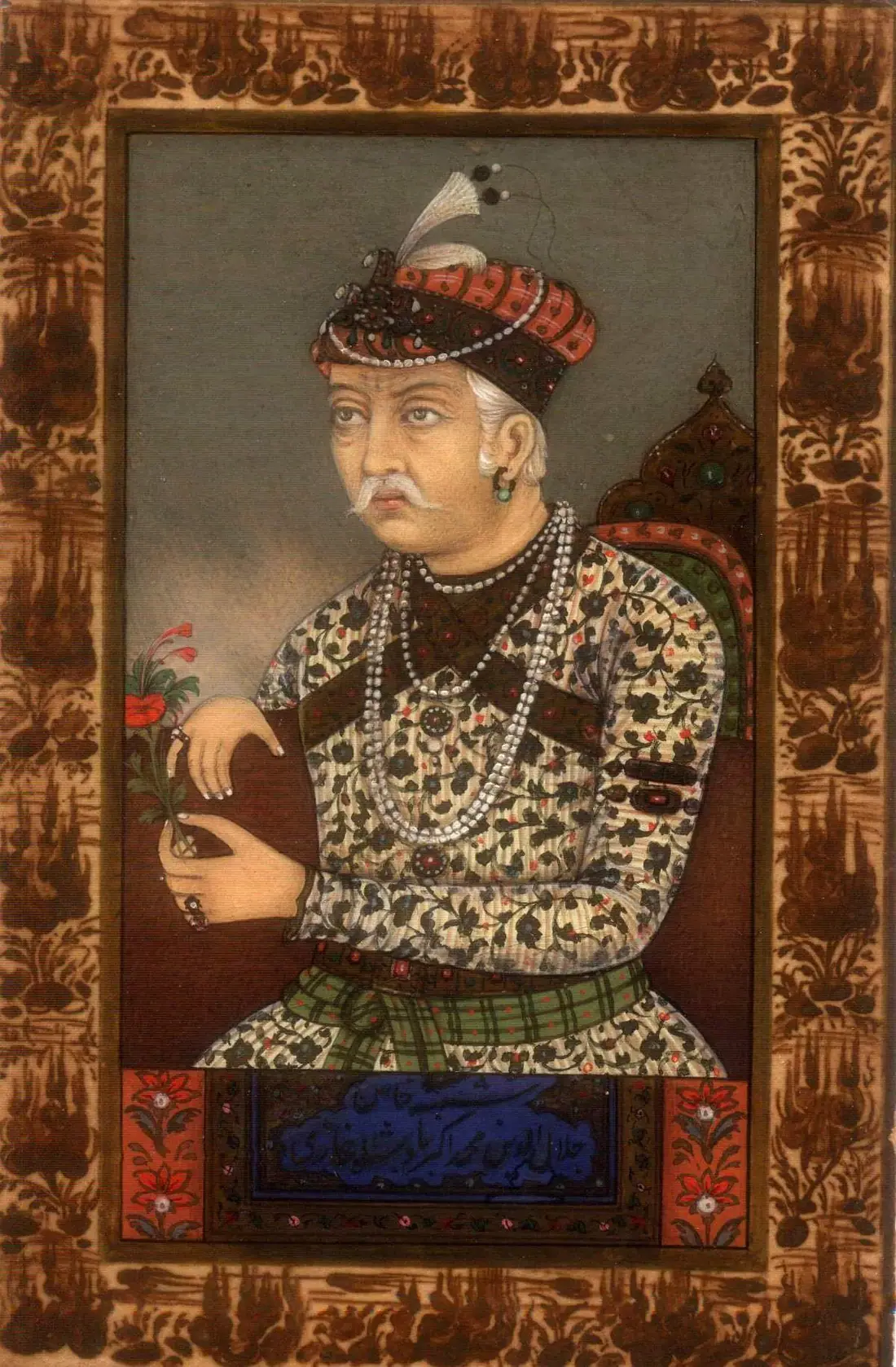
From the mid-sixteenth century the single-page painting grew in prominence in Mughal art. Such pages, with illuminated calligraphy, were collected and bound into albums called muraqqas, a practice that began in Iran in the early fifteenth century. The Metropolitan Museum places the earliest written evidence of Mughal albums in Akbar’s reign and the earliest surviving albums in Jahangir’s. In the Shah Jahan Album, studies of nature and individualised portraits predominate.
Shah Jahan ruled from 1628 to 1658. His artists produced the illustrations of the Padshahnama. Britannica says he reserved most of his patronage for architecture, and that the paintings of his time kept their technical sophistication but lost some of the vitality of Jahangir’s. The tradition declined after Aurangzeb, and creative activity ceased in the reign of Shah Alam II, who ruled from 1759 to 1806.
Miniature traditions at Fakir Khana
Fakir Khana Museum lists its miniatures as Mughal, Persian, Rajput, Kangra and Pahari traditions. In a Mughal court picture, look first at the faces, which portraitists finished after the colour had been built up in layers, and then at the burnished surface.

Britannica treats Rajput painting as the art of the independent Hindu feudal states, as distinguished from the court art of the Mughal emperors, and divides it into Rajasthani and Pahari painting. Pahari painting developed in the independent states of the Himalayan foothills and has two contrasting schools: the bold Basohli, whose earliest known work dates from about 1690, and the delicate, lyrical Kangra. Kangra, from the mid-eighteenth century, shows late Mughal influence, with less intense colours, more naturalistic landscape and a more refined, delicate line. Artist families trained in the late Mughal style apparently fled Delhi for the hills.
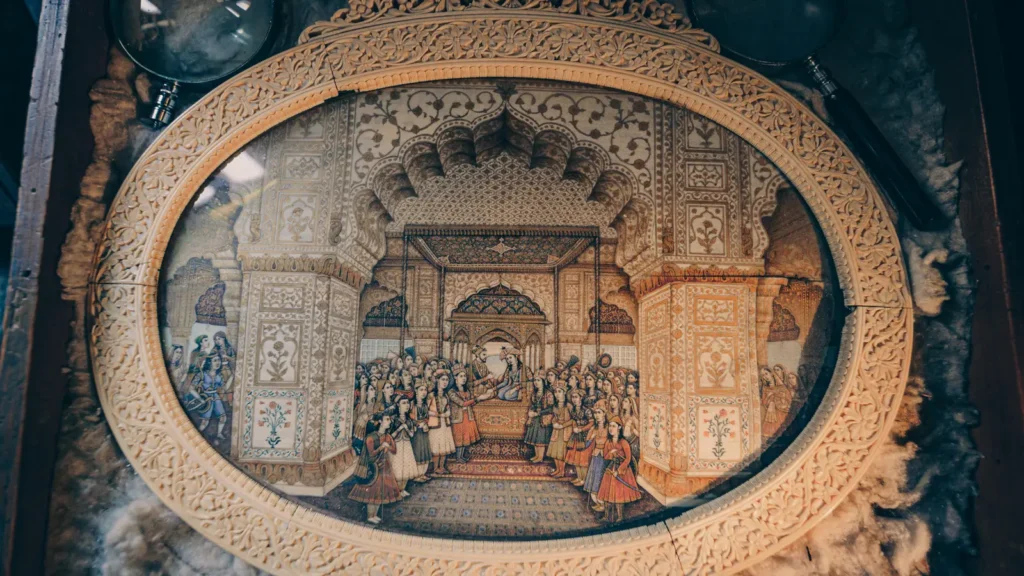
The museum describes The Ladies’ Court of Shah Jehan as painted on a single piece of ivory, with gold and other precious and semi-precious stone colours, and showing 42 figures besides the king and queen. The museum gives no date, maker or school for it. The portrait of Nawab Mumtaz Ali Khan is traditionally said to have been painted over fifteen years with a brush of a single hair, and the museum gives its size as about 12 by 6 inches. Gulf News reported in 2018 that there was a magnifying glass nearby for visitors to have a closer look.
Visits are by appointment. Call or write to arrange one, and ask then what is on show and about admission. Contact details are on the Visit page.
Explore the collection to see the museum’s portraits and miniatures online.
Frequently Asked Questions
What is a Mughal miniature painting?
Britannica describes Mughal painting as a style that evolved in India under the Mughal emperors, who ruled from the sixteenth to the eighteenth century. It was essentially a court art, made mostly as manuscript illustrations and miniatures, with some individual pieces for albums. Its subjects were generally secular, from portraits of the emperor and his court to studies of natural life.
How were Mughal miniatures traditionally made?
Britannica says Mughal illustrations were painted mostly on cotton-fibre paper with fine brushes, from a charcoal or ink drawing, with colour built up in layers, often by different hands. The surface was burnished several times. A University of the Punjab study describes wasli, four or eight layers of glued paper depending on the size of the miniature, with gold applied last.
How do Rajput, Pahari and Kangra miniatures differ from Mughal paintings?
Britannica describes Rajput painting as the art of the independent Hindu feudal states, as distinguished from the court art of the Mughal emperors, and divides it into Rajasthani and Pahari painting. Pahari painting includes the bold Basohli school, whose earliest known work dates from about 1690, and the lyrical Kangra school, which from the mid-eighteenth century shows late Mughal influence.
What miniature paintings can I see at Fakir Khana Museum?
The museum lists its miniatures as Mughal, Persian, Rajput, Kangra and Pahari traditions. It describes The Ladies’ Court of Shah Jehan as painted on a single piece of ivory and showing 42 figures besides the king and queen. Visits are by appointment. Call or write to arrange one, and ask then what is on show.
Sources and Further Reading
- Mughal painting – Encyclopaedia Britannica — Definition, subjects, Persian roots, the Hamzanama, Jahangir and Shah Jahan, paper, pigments, burnishing and albums
- The Art of the Mughals before 1600 – The Metropolitan Museum of Art — Akbar’s royal atelier at Fatehpur Sikri and then Lahore, and the mixed origins of his artists
- The Shah Jahan Album – The Metropolitan Museum of Art — The single-page painting and the practice of binding pages into albums
- Traditional Materials Used by the Miniature Artists: An Introductory Study – Kanwal Khalid, University of the Punjab — Wasli of four or eight layers, the fine brush, gold applied last and the final burnishing
- Rajput painting – Encyclopaedia Britannica — Rajput painting as the art of the independent Hindu feudal states
- Pahari painting – Encyclopaedia Britannica — Pahari painting, the Basohli and Kangra schools, and late Mughal influence at Kangra
- The Ladies’ Court of Shah Jehan – Google Arts & Culture — The museum’s description of the ivory support, the gold and stone colours and the 42 figures
- A museum is witness to Lahore’s rich past – Gulf News (2018) — A magnifying glass reported near the portrait of Nawab Mumtaz Ali Khan