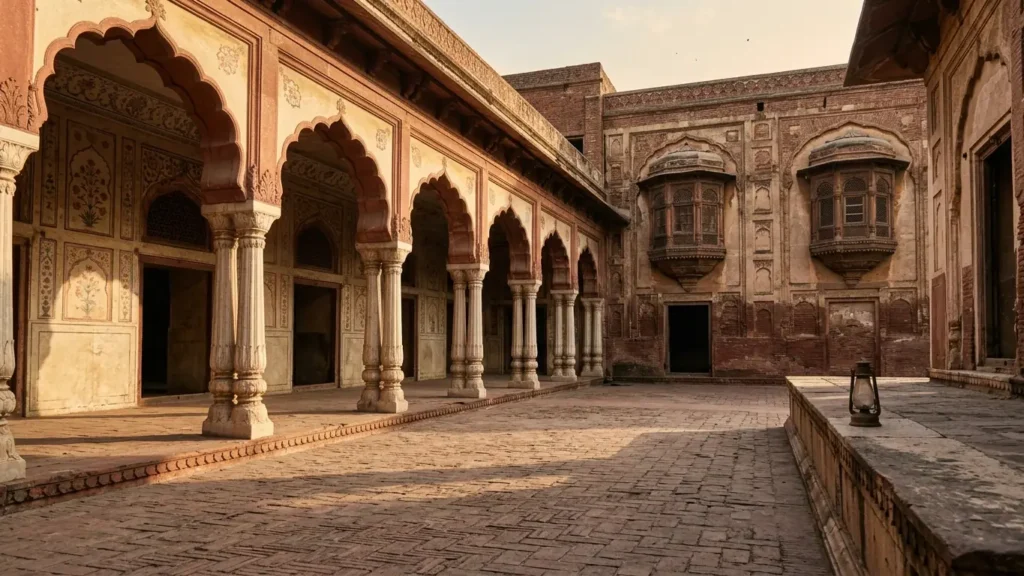
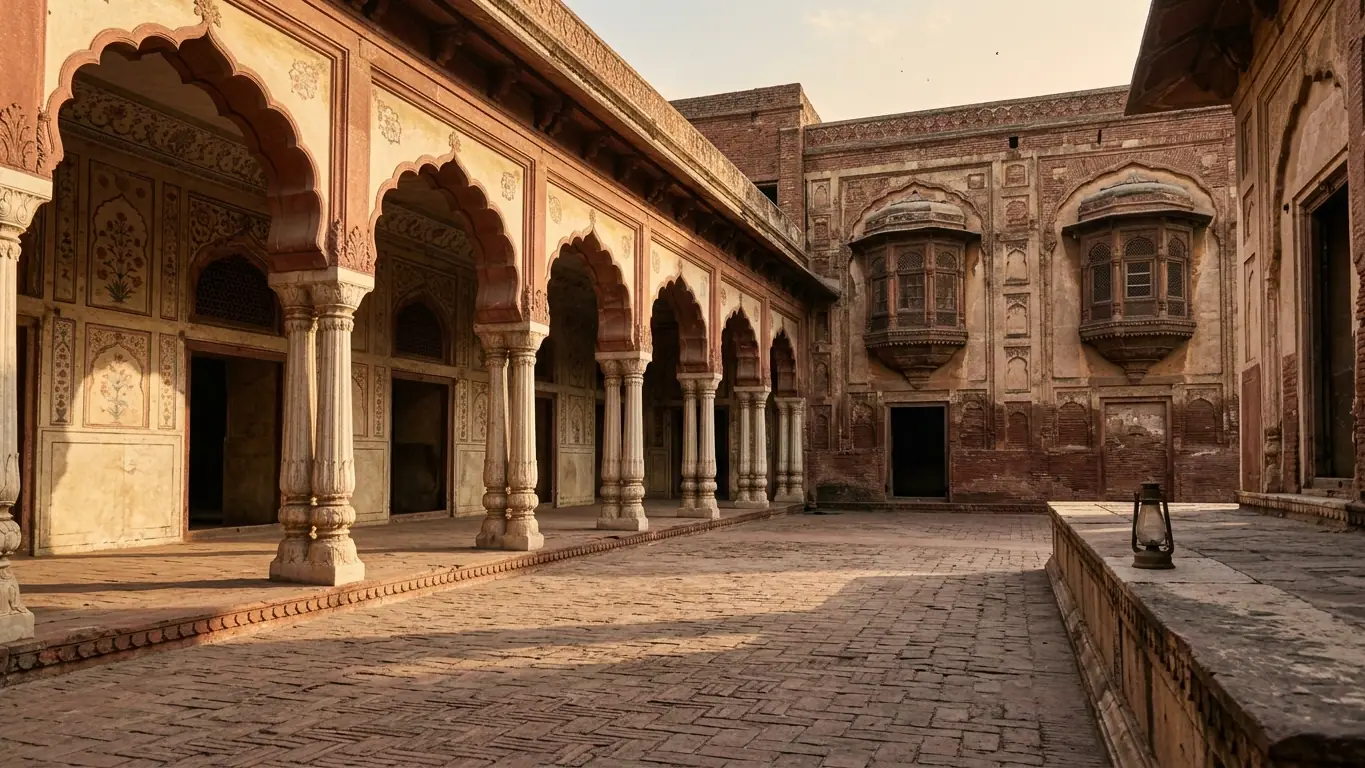
The samadhi of Maharaja Ranjit Singh stands in Lahore’s Walled City, beside Lahore Fort, the Badshahi Mosque and Gurdwara Dera Sahib. Work began in August 1839, under his eldest son and successor, Kharak Singh, on the spot where the Maharaja had been cremated after his death on 27 June 1839. Accounts differ on when it was finished.
Where the samadhi stands
The samadhi stands beside Roshnai Gate, which lies between Lahore Fort and the Badshahi Mosque, and next to Gurdwara Dera Sahib, which Wikipedia describes as commemorating the place where Guru Arjan Dev died. The Walled City of Lahore Authority describes the gate as having two structures, one of them beside the samadhi.
The samadhi’s local names are samadh and marhi. It is a religious place for Sikh visitors, and for several decades the building served both as a memorial and as a gurdwara.
Building the memorial
The art historian Nadhra Khan, whose monograph is the standard study of the building, gives 28 June 1839, the day after Ranjit Singh’s death, as the date of the cremation. After a stately farewell, she writes, proposals for a grand funerary monument like Jahangir’s tomb at Shahdara were considered, and a more modest samadhi was begun in August by Kharak Singh.
The court chronicler Sohan Lal Suri and others give few details of the plan or the money allotted, Khan notes. Building and decoration went on despite the challenges and a changing political scene at the Lahore Darbar, and infighting between factions slowed the work. Khan calls the samadhi the last state-funded grand project of the Lahore Darbar before the British annexation of 1849.
What family accounts say about Nuruddin
Family accounts, set down by the historian F.S. Aijazuddin in 2002, record that Fakir Nuruddin supervised the construction of the samadhi near Roshnai Gate. Aijazuddin, a historian from the Fakir family, writes that this was a final act of loyalty to the Maharaja’s memory.
Architecture and the smaller samadhis
Descriptions of the building speak of a mix of Sikh, Hindu and Islamic elements: gilded fluted domes and cupolas with an ornate balustrade round the top, a red sandstone doorway carrying images of Ganesh, Devi and Brahma, Naga-hood designs on the dome, and wooden ceiling panels with stained glass beside glass mosaic ceilings.
Khan describes fine carving in red sandstone, white marble and wood, pietra dura inlay in white marble with coloured and semi-precious stones, mirror mosaic and frescoes, almost all preserved in their original forms. She calls the samadhi the high point of nineteenth-century Sikh architecture in the Punjab, second only to the Golden Temple at Amritsar, and counts forty-eight fresco wall paintings on the two levels of the interior. Wikipedia describes them as a mix of Pahari and Punjabi styles with Sikh and Hindu religious themes.
Khan reports that the platform inside the samadhi once held fourteen carved marble knobs, the largest for the Maharaja. In her 2016 article she says they were no longer on the platform: the largest was missing, and twelve of the thirteen smaller ones were in a storeroom at the Dera Sahib complex. She writes that there were no ashes in the knobs.
The building first stood on eight pillars, which cracked. The British authorities had the roof supported by eight more pillars beside the originals, with iron clamps and rings on the cracked columns, so that it now stands on sixteen.
In 1876 Thornton and Kipling judged the design substantially Hindu, overlaid with Muhammadan details, and in 1961 Waliullah Khan called it an unhappy mixture. Nadhra Khan argues that these accounts missed its distinctively Sikh features and that nineteenth-century handbooks shaped later opinion. The large marble door frame of the main entrance is said to have come from the Sheesh Mahal of Lahore Fort, a story told since the nineteenth century; Nadhra Khan treats the wider tale of looting as a legacy of Thornton’s bias.
The complex also holds the samadhis of Ranjit Singh’s son Kharak Singh and grandson Prince Nau Nihal Singh. Wikipedia reports that the samadhi of Maharani Jind Kaur was also there and has since been demolished.
Where the sources differ
The Walled City of Lahore Authority, Wikipedia and Pakistan Today give 1848, under Duleep Singh, as the year of completion. Khan calls that date erroneous and writes that the building was nearly complete at the 1849 annexation and finished under British rule; Live History India gives 1851. Guides often place the Maharaja’s ashes in a lotus-shaped urn, while Khan, working from the court chronicle, writes that they were sent to Hardwar for immersion in the Ganges.
Visiting the samadhi
According to published accounts, the Evacuee Trust Property Board looks after the samadhi. Wikipedia says visiting is permitted to local or visiting Sikhs, and that others need special permission from the Board. Pakistan Today described the site in 2016 as not easily accessible to the public and not a tourist site, with several permissions and security checks required. Rules can change, so check with the Board before you plan a visit.
In June 2026 the Board held a ceremony at Gurdwara Dera Sahib for the 187th anniversary of Ranjit Singh’s death.
Fakir Khana Museum, in the Walled City, is a separate visit. Visits are by appointment. Call or write to arrange one, using the details on the Visit page.
Frequently Asked Questions
Where is the Samadhi of Maharaja Ranjit Singh?
It stands in Lahore’s Walled City beside Roshnai Gate, between Lahore Fort and the Badshahi Mosque, next to Gurdwara Dera Sahib. Work began in August 1839, under his eldest son, Kharak Singh, on the spot where the Maharaja had been cremated after his death on 27 June 1839.
Are Ranjit Singh’s ashes inside the samadhi?
Guides often say his ashes lie in a lotus-shaped marble urn. The art historian Nadhra Khan, working from the court chronicle, writes that they were sent to Hardwar for immersion in the Ganges, and that the marble knobs once displayed on the platform held no ashes. Her 2016 article reports that the knobs had been taken off the platform.
When was the Samadhi of Ranjit Singh completed?
Work began in August 1839 under Kharak Singh. A widely repeated account says Duleep Singh finished it in 1848. Nadhra Khan writes that it was only nearly complete at the British annexation of 1849 and was finished later under British rule, and 1851 is the year often given.
Who supervised the building of Ranjit Singh’s samadhi?
Family accounts, set down by the historian F.S. Aijazuddin in 2002, record that Fakir Nuruddin supervised its construction near Roshnai Gate. Aijazuddin is a historian from the Fakir family and describes this as a final act of loyalty to the Maharaja’s memory.
Can visitors enter the samadhi?
According to published accounts, the Evacuee Trust Property Board looks after it. Wikipedia says visiting is permitted to local or visiting Sikhs, with special permission from the Board needed by others, and Pakistan Today in 2016 described the site as not easily accessible. Rules can change, so check with the Board first.
Sources and Further Reading
- Samadhi of Ranjit Singh, Wikipedia — Location, local names, Gurdwara Dera Sahib, the decoration, the smaller samadhis, the access rules and the 1848 completion account.
- Nadhra Shahbaz Naeem Khan, The Samadhi of Maharaja Ranjit Singh in Lahore (2018), Introduction — The August 1839 start under Kharak Singh, the thin record of the plan, the critical reception and the pillars.
- Sikh Art and Architecture in Lahore: In the Eyes of Nadhra Khan, SikhNet — Khan on the materials, the ranking of the building and the completion under British rule.
- Monuments, Walled City of Lahore Authority — The site of the cremation, the domes and balustrade, and the 1848 completion account.
- Nadhra Shahbaz Naeem Khan (2016), Sikh Research Journal — The cremation on 28 June 1839 and the ashes sent to Hardwar.
- Samadhi of Ranjit Singh: a sight of religious harmony, Pakistan Today (2016) — Roshnai Gate, the smaller samadhis, the Evacuee Trust Property Board and the access description.
- F.S. Aijazuddin, article for the SGPC (2002) — Fakir Nuruddin’s supervision of the construction, as recorded by a historian from the Fakir family.
- Ranjit Singh’s Lahore, Live History India — The date of death and 1851 as a year for the completion.
- Central ceremony held to mark the 187th death anniversary of Maharaja Ranjit Singh, Evacuee Trust Property Board — The June 2026 ceremony at Gurdwara Dera Sahib.
- Ranjit Singh (1780-1839), Encyclopaedia of Sikhism — The date of Ranjit Singh’s death, 27 June 1839.